
GCSE Physics (AQA)
346 videos | 23 hours
Please subscribe to watch this video.
This, and all other videos, are included in our premium subscriptions.
Premium accounts get access to all videos.
Enable autoplay to keep watching
Your browser is blocking videos from playing automatically. To turn it back on:
Safari (Mac): Click the Safari menu item in the top bar, then Settings → Websites → Auto-Play, then set Auto-Play to Allow All Auto-Play for the current website.
Safari (iPhone/iPad): open the Settings app, then Apps → Safari → Auto-Play, and select Allow All Auto-Play.
Magnetism and electromagnetism
Induced potential, transformers and the National Grid
Generator Effect in a Transformer
3:12
Transformers
Spec
4.7.3.1
4.7.3.4
- Transformers use induced magnetic fields and the generator effect to transfer alternating current.
- They change the potential difference of a current.
- An alternating current source in the primary coil produces an output alternating current with a different potential difference in the secondary coil.
- The process involves inducing a changing magnetic field around the primary coil.
- The direction of the induced field depends on the current's direction, which changes periodically with alternating current.
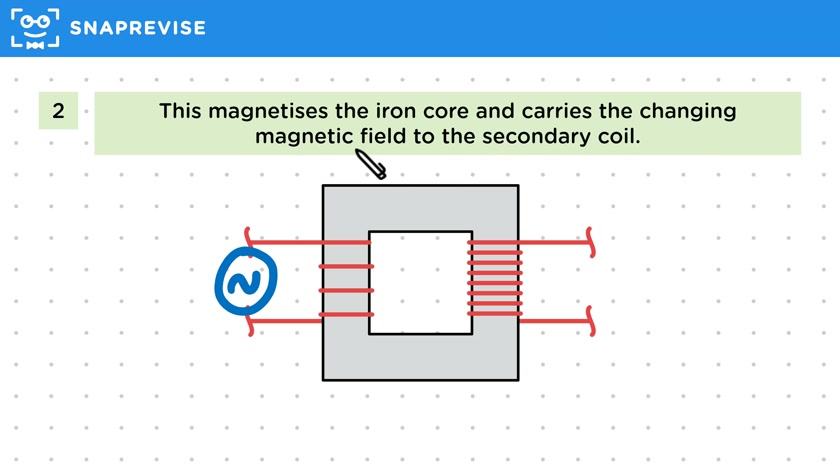
- The iron core is magnetized, carrying the changing magnetic field to the secondary coil without loss of strength.
- The changing magnetic field induces an alternating current in the secondary coil due to the generator effect.
- The generator effect occurs when a magnetic field induces a potential difference and current in a conductor.
- Transformers do not work with direct currents as no generator effect occurs without a changing field.
- The number of turns in the secondary coil affects the potential difference of the output.
Please subscribe to access these revision notes.
This, and all other video notes, are included in our premium subscriptions.
Premium accounts get access to all videos and revision notes.
Report an Issue
Spotted something wrong? Let us know and we'll take a look.