
GCSE Combined Science (AQA)
622 videos | 38 hours
Please subscribe to watch this video.
This, and all other videos, are included in our premium subscriptions.
Premium accounts get access to all videos.
Enable autoplay to keep watching
Your browser is blocking videos from playing automatically. To turn it back on:
Safari (Mac): Click the Safari menu item in the top bar, then Settings → Websites → Auto-Play, then set Auto-Play to Allow All Auto-Play for the current website.
Safari (iPhone/iPad): open the Settings app, then Apps → Safari → Auto-Play, and select Allow All Auto-Play.
Atomic structure and the periodic table
A simple model of the atom, symbols, relative atomic mass, electronic charge and isotopes
Development of the Atomic Model
10:14
Development of the Atomic Model
Spec
4.1.1.3
- Ideas about atoms have evolved over time due to new experimental evidence.
- Atoms are incredibly small and cannot be seen directly; scientists make theories and predictions about their structure.
- Early atomic models were simple and evolved into the current atomic structure.
- Initially, atoms were thought to be indivisible spheres, a concept from ancient Greeks.
- Discovery of the electron led to the plum pudding model, suggesting atoms are positive spheres with embedded negative electrons.
- The plum pudding model was challenged by the alpha particle scattering experiment led by Ernest Rutherford.
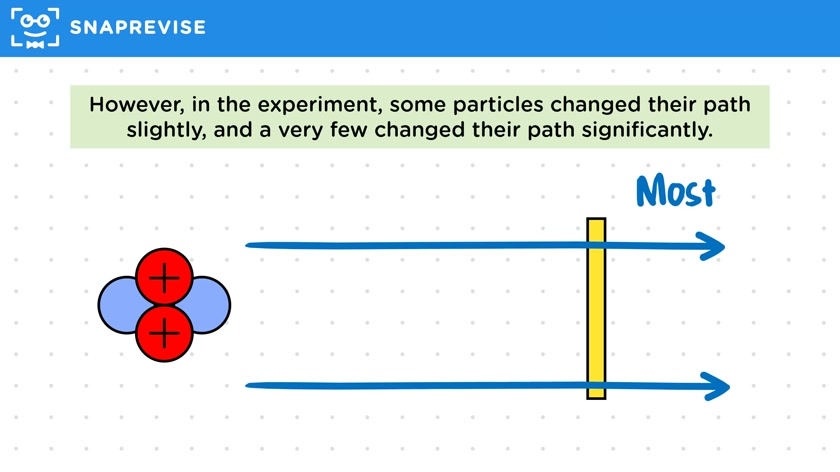
- Alpha particles, consisting of two protons and two neutrons, were directed at gold foil.
- The experiment showed some particles passed through, some deflected slightly, and a few deflected significantly.
- This led to the nuclear model of the atom, with a concentrated positive nucleus and electrons surrounding it.
- Key differences between the plum pudding and nuclear models:
- Plum pudding model: no nucleus, solid, evenly distributed positive charge, mass spread throughout, electrons embedded.
- Nuclear model: small, dense, positively charged nucleus, mostly empty space, concentrated positive charge in nucleus, mass in nucleus, electrons orbiting nucleus.
Please subscribe to access these revision notes.
This, and all other video notes, are included in our premium subscriptions.
Premium accounts get access to all videos and revision notes.
Report an Issue
Spotted something wrong? Let us know and we'll take a look.