
GCSE Combined Science (AQA)
622 videos | 38 hours
Please subscribe to watch this video.
This, and all other videos, are included in our premium subscriptions.
Premium accounts get access to all videos.
Enable autoplay to keep watching
Your browser is blocking videos from playing automatically. To turn it back on:
Safari (Mac): Click the Safari menu item in the top bar, then Settings → Websites → Auto-Play, then set Auto-Play to Allow All Auto-Play for the current website.
Safari (iPhone/iPad): open the Settings app, then Apps → Safari → Auto-Play, and select Allow All Auto-Play.
Atomic structure
Atoms and nuclear radiation
Radioactive Activity
3:11
Radioactive Acivity
Spec
4.4.2.1
- Activity is the rate of nuclear decay in a sample with unstable nuclei.
- Nuclear decay is random and not evenly spread over time.
- Activity is best measured over long periods or with large numbers of decays to reduce variation.
- Activity is measured in becquerels (Bq), where one Bq equals one decay per second.
- Activity can be calculated by dividing the number of decays by time.
- The activity of a sample depends on the isotope and sample size.
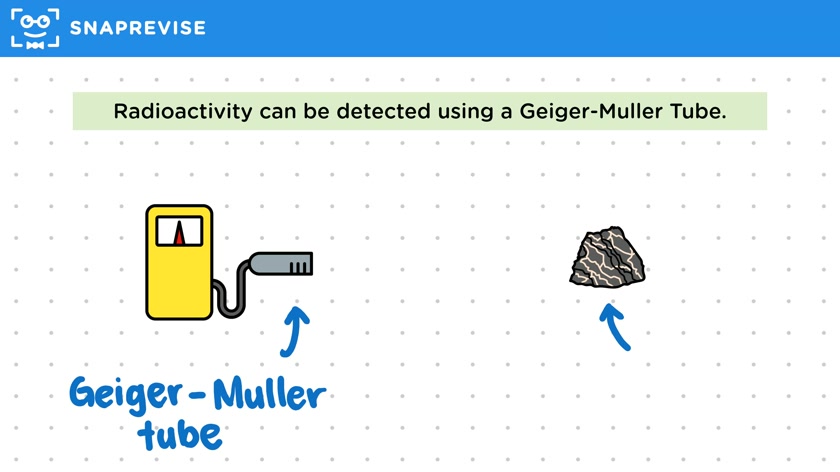
- Radioactivity is detected using a Geiger-M��ller tube (GM tube).
- GM tube has a clicker dial and a tube directed at the radioactive source.
- Common radioactive sources include radium, uranium, and plutonium.
- Safety measures include keeping a safe distance, wearing protective clothing, and storing the source after measurement.
- The Geiger-M��ller tube clicks when radiation is detected.
- Count rate is the number of nuclear decays detected per second by the GM tube.
- Count rate is calculated by dividing the number of counts by time.
- Longer counting periods lead to more accurate count rates.
- Count rate is less than the actual activity because the GM tube detects only some of the radiation.
- Radiation is emitted in all directions, but only a small amount is measured.
- Count rate helps calculate activity, but detailed knowledge is not required for exams.
- Background radiation can contribute to counts, which should be checked.
Please subscribe to access these revision notes.
This, and all other video notes, are included in our premium subscriptions.
Premium accounts get access to all videos and revision notes.
Report an Issue
Spotted something wrong? Let us know and we'll take a look.