
GCSE Combined Science (AQA)
622 videos | 38 hours
Please subscribe to watch this video.
This, and all other videos, are included in our premium subscriptions.
Premium accounts get access to all videos.
Enable autoplay to keep watching
Your browser is blocking videos from playing automatically. To turn it back on:
Safari (Mac): Click the Safari menu item in the top bar, then Settings → Websites → Auto-Play, then set Auto-Play to Allow All Auto-Play for the current website.
Safari (iPhone/iPad): open the Settings app, then Apps → Safari → Auto-Play, and select Allow All Auto-Play.
Atomic structure
Atoms and nuclear radiation
Ionisation
3:17
Radioactive Acivity
Spec
4.4.2.1
- Radiation can ionize atoms by removing or adding electrons.
- Ionization gives an atom a charge.
- A neutral atom has electrons orbiting a central nucleus.
- An alpha particle consists of two protons and two neutrons and can be released by an unstable nucleus.
- Alpha particles have a strong positive charge due to their protons.
- Alpha particles can pull electrons out of orbit due to electrostatic attraction, forming positive ions.
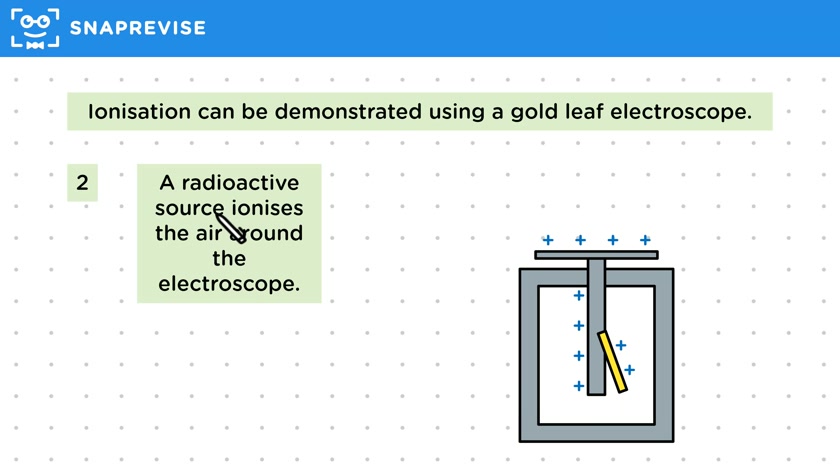
- Ionization can be demonstrated using a gold leaf electroscope.
- An electroscope consists of a metal plate connected to a rod with a charged thin gold leaf attached.
- The gold leaf is repelled from the metal stem due to electrostatic repulsion when both are positively charged.
- A radioactive source can ionize the air around the electroscope, producing positive and negative ions.
- Negatively charged air particles are attracted to the electroscope, neutralizing it and causing the gold leaf to drop.
- Ionization can cause damage to body tissues, including DNA mutations or deficiencies.
- Radiation can harm or kill cells, acting like a bullet when hitting DNA directly.
- Caution is necessary when handling radioactive materials.
Please subscribe to access these revision notes.
This, and all other video notes, are included in our premium subscriptions.
Premium accounts get access to all videos and revision notes.
Report an Issue
Spotted something wrong? Let us know and we'll take a look.