
GCSE Combined Science (AQA)
622 videos | 38 hours
Please subscribe to watch this video.
This, and all other videos, are included in our premium subscriptions.
Premium accounts get access to all videos.
Enable autoplay to keep watching
Your browser is blocking videos from playing automatically. To turn it back on:
Safari (Mac): Click the Safari menu item in the top bar, then Settings → Websites → Auto-Play, then set Auto-Play to Allow All Auto-Play for the current website.
Safari (iPhone/iPad): open the Settings app, then Apps → Safari → Auto-Play, and select Allow All Auto-Play.
Atomic structure
Atoms and nuclear radiation
Unstable Nuclei
2:07
Radioactive Acivity
Spec
4.4.2.1
- Most atomic nuclei are stable and unchanged for millions of years.
- Nucleus consists of protons and neutrons held by strong forces.
- Nuclei remain unchanged during chemical reactions; only electron configurations change.
- Some nuclei are unstable and struggle to hold together.
- Large numbers of protons or neutrons can cause instability.
- GCSE level does not require detailed knowledge of nuclear stability.
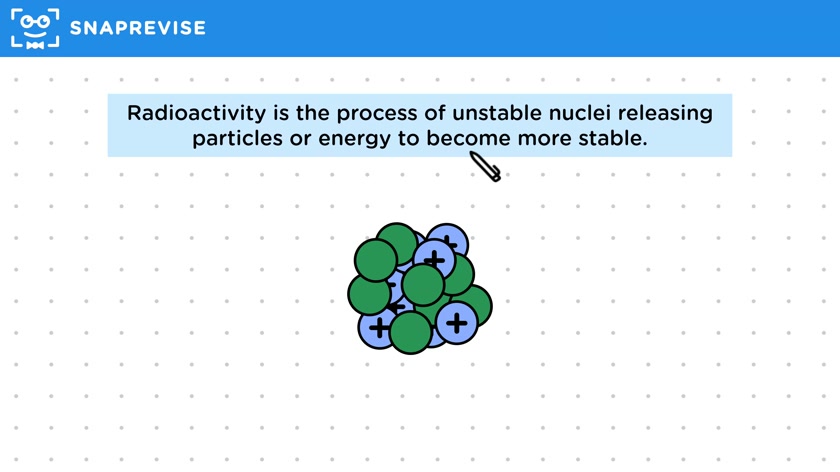
- Unstable nuclei release particles or energy to become stable, a process known as radioactivity.
- Nuclear decay involves the nucleus becoming smaller and more stable.
- Alpha radiation is one type of radiation released during decay.
- Nuclear decay is a random process dependent on the nucleus's nature.
- Decay rate is similar for similar nuclei and is not affected by external conditions like temperature.
- Nuclear decay is unpredictable and cannot be controlled or altered by humans.
- Understanding the randomness and unpredictability of nuclear decay is important for exams.
Please subscribe to access these revision notes.
This, and all other video notes, are included in our premium subscriptions.
Premium accounts get access to all videos and revision notes.
Report an Issue
Spotted something wrong? Let us know and we'll take a look.