
GCSE Combined Science (AQA)
622 videos | 38 hours
Please subscribe to watch this video.
This, and all other videos, are included in our premium subscriptions.
Premium accounts get access to all videos.
Enable autoplay to keep watching
Your browser is blocking videos from playing automatically. To turn it back on:
Safari (Mac): Click the Safari menu item in the top bar, then Settings → Websites → Auto-Play, then set Auto-Play to Allow All Auto-Play for the current website.
Safari (iPhone/iPad): open the Settings app, then Apps → Safari → Auto-Play, and select Allow All Auto-Play.
Atomic structure and the periodic table
A simple model of the atom, symbols, relative atomic mass, electronic charge and isotopes
Protons, Electrons & Neutrons
5:16
Atomic Structure
Spec
4.1.1.4
4.1.1.5
- Atoms consist of a dense central nucleus surrounded by electrons in shells.
- The nucleus is made of subatomic particles called protons and neutrons.
- Electrons are subatomic particles found in shells around the nucleus.
- Protons and neutrons are found in the nucleus, while electrons are in the outer shells.
- All nuclei contain protons; most contain neutrons, but some, like hydrogen, may not.
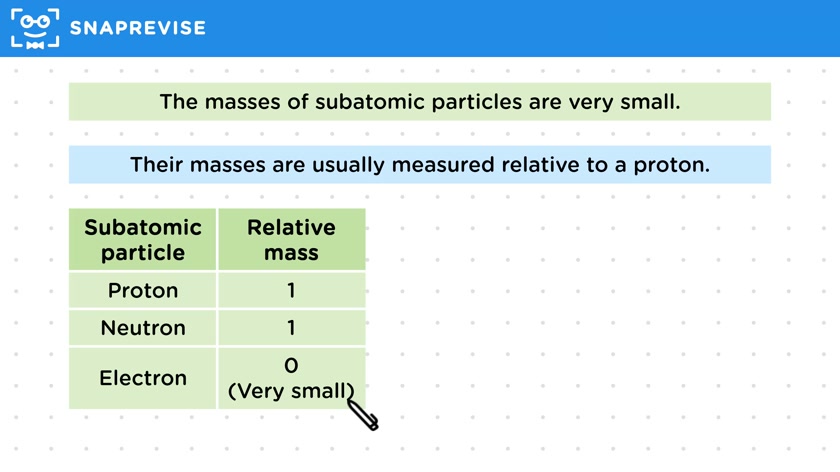
- Subatomic particles have very small masses, often measured relative to a proton.
- Protons and neutrons have a relative mass of one, while electrons have a negligible mass.
- 99% of an atom's mass is concentrated in the nucleus due to protons and neutrons.
- Protons have a positive charge (+1), neutrons are neutral (0), and electrons have a negative charge (-1).
- Atoms have the same number of electrons as protons, resulting in no overall electrical charge.
- In a carbon atom, six protons (+6) and six electrons (-6) cancel each other out, resulting in a neutral charge.
Please subscribe to access these revision notes.
This, and all other video notes, are included in our premium subscriptions.
Premium accounts get access to all videos and revision notes.
Report an Issue
Spotted something wrong? Let us know and we'll take a look.