
GCSE Combined Science (AQA)
622 videos | 38 hours
Please subscribe to watch this video.
This, and all other videos, are included in our premium subscriptions.
Premium accounts get access to all videos.
Enable autoplay to keep watching
Your browser is blocking videos from playing automatically. To turn it back on:
Safari (Mac): Click the Safari menu item in the top bar, then Settings → Websites → Auto-Play, then set Auto-Play to Allow All Auto-Play for the current website.
Safari (iPhone/iPad): open the Settings app, then Apps → Safari → Auto-Play, and select Allow All Auto-Play.
Atomic structure and the periodic table
A simple model of the atom, symbols, relative atomic mass, electronic charge and isotopes
Atomic Number & Mass Number
6:38
Atomic and Mass Number: Subatomic Particles and Size
Spec
4.1.1.4
4.1.1.5
- Atoms of an element always have the same number of protons.
- Oxygen atoms have exactly eight protons.
- The atomic number of an atom is its number of protons, also referred to as the proton number.
- Different elements have different numbers of protons.
- Carbon atoms have 12 protons, nitrogen atoms have 14 protons.
- Atomic nuclei contain protons and neutrons.
- Lithium atom example: 3 protons (atomic number) and 4 neutrons.
- Mass number is the sum of protons and neutrons.
- Lithium has a mass number of seven.
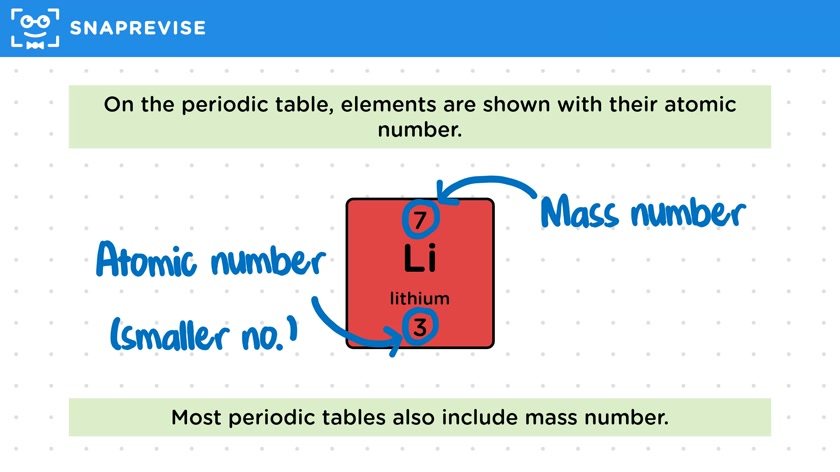
- Periodic table displays elements with their atomic number.
- Atomic number is the number of protons in the nucleus.
- Mass number is usually larger than the atomic number.
- Not all periodic tables display the mass number.
- Atomic number and mass number help calculate subatomic particles.
- Magnesium example: 12 protons, 12 electrons, 12 neutrons.
- Sodium example: 11 protons, 11 electrons, 12 neutrons.
- Calculation of neutrons: mass number minus atomic number.
Please subscribe to access these revision notes.
This, and all other video notes, are included in our premium subscriptions.
Premium accounts get access to all videos and revision notes.
Report an Issue
Spotted something wrong? Let us know and we'll take a look.