
GCSE Combined Science (AQA)
622 videos | 38 hours
Please subscribe to watch this video.
This, and all other videos, are included in our premium subscriptions.
Premium accounts get access to all videos.
Enable autoplay to keep watching
Your browser is blocking videos from playing automatically. To turn it back on:
Safari (Mac): Click the Safari menu item in the top bar, then Settings → Websites → Auto-Play, then set Auto-Play to Allow All Auto-Play for the current website.
Safari (iPhone/iPad): open the Settings app, then Apps → Safari → Auto-Play, and select Allow All Auto-Play.
Atomic structure
Atoms and isotopes
Alpha Scattering
7:45
History of the Atom
Spec
4.4.1.3
- In 1909, Hans Geiger and Earnest Marsden conducted an experiment directing alpha particles at gold foil.
- The experiment aimed to investigate unexplained behavior of alpha particles and led to discoveries about atomic structure.
- Alpha particles are radiation consisting of two protons and two neutrons, similar to helium ions with a strong positive charge.
- The experiment involved firing alpha particles at a thin gold foil, only a few atoms thick.
- The plumb pudding model suggested alpha particles would pass through the gold without being affected.
- Scientists believed atoms consisted of electrons embedded in positive spheres of matter with evenly distributed mass and charge.
- Contrary to expectations, some alpha particles were slightly deflected, and a small number bounced back.
- Charged plates detected the paths of alpha particles, showing most passed straight through, but some were deflected.
- Some particles had large deflections of more than 90 degrees, contradicting the plumb pudding model.
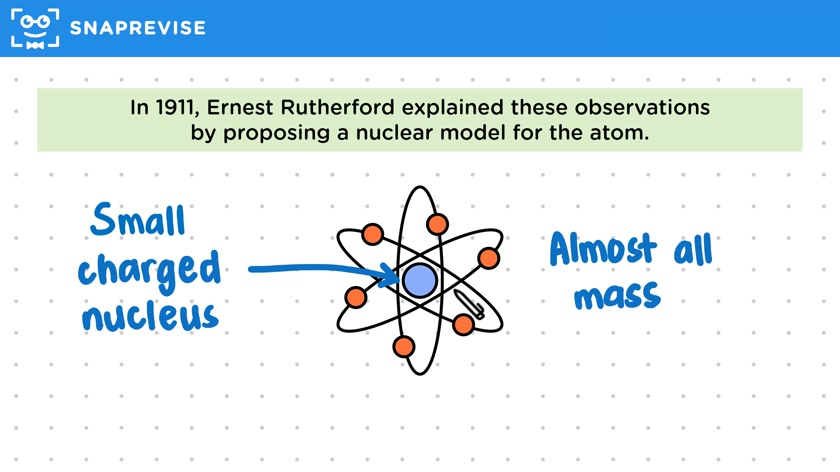
- In 1911, Ernest Rutherford proposed a nuclear model for the atom, explaining the observations.
- Rutherford theorized atoms contained a small charged nucleus surrounded by electrons, with the nucleus containing most of the atom's mass.
- The nucleus was later confirmed to be positively charged, balancing the negative charge of electrons.
- The nuclear model explained that only a few alpha particles were heavily deflected due to the small size of the nucleus compared to the atom.
- Most alpha particles passed through the atom unaffected, as they didn't come into contact with the nucleus.
- The nucleus must have a large mass to not be affected by the forces deflecting the alpha particles.
- Modern experiments show the nucleus contains over 99% of the atom's mass.
- The nucleus must be charged to cause deflections of particles passing close by, with more particles undergoing partial deflections.
- Assuming the nucleus is positively charged, alpha particles experience repulsive electrostatic forces causing path bending.
- Rutherford initially considered the nucleus could be negatively charged, causing attractive forces and strong deflection through slingshotting.
Please subscribe to access these revision notes.
This, and all other video notes, are included in our premium subscriptions.
Premium accounts get access to all videos and revision notes.
Report an Issue
Spotted something wrong? Let us know and we'll take a look.