
GCSE Combined Science (AQA)
622 videos | 38 hours
Please subscribe to watch this video.
This, and all other videos, are included in our premium subscriptions.
Premium accounts get access to all videos.
Enable autoplay to keep watching
Your browser is blocking videos from playing automatically. To turn it back on:
Safari (Mac): Click the Safari menu item in the top bar, then Settings → Websites → Auto-Play, then set Auto-Play to Allow All Auto-Play for the current website.
Safari (iPhone/iPad): open the Settings app, then Apps → Safari → Auto-Play, and select Allow All Auto-Play.
Atomic structure
Atoms and isotopes
The Plum Pudding Model
2:15
History of the Atom
Spec
4.4.1.3
- In 1897, JJ Thompson observed particles traveling between oppositely charged hot metal plates.
- The experiment involved two charged plates with a potential difference between them.
- A small particle released from one plate would move between the plates due to the electrostatic force.
- The particle could be detected by measuring the change of charge on the plates.
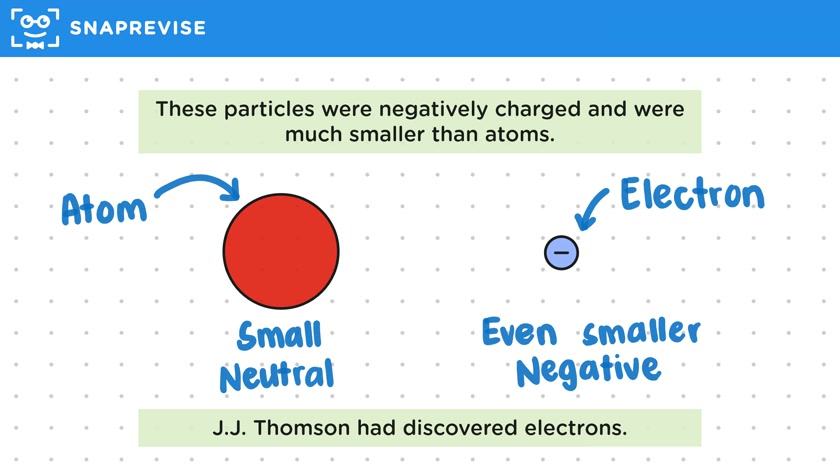
- These particles were negatively charged and much smaller than atoms.
- Discovering a particle smaller than an atom was significant as it proved atoms weren't the smallest pieces of matter.
- Electrons had a negative charge as they were repelled from negative and attracted to positive plates.
- JJ Thompson discovered electrons.
- In 1904, Thompson presented a new model for the atom to explain the existence of electrons, known as the plum pudding model.
- The plum pudding model suggested that atoms contained electrons.
- The model depicted the atom as a ball of positive charge with negatively charged electrons embedded inside, like plums in a plum pudding.
- The electrons were evenly spread out within the positive charge.
- The plum pudding model influenced later experiments looking into the atom.
Please subscribe to access these revision notes.
This, and all other video notes, are included in our premium subscriptions.
Premium accounts get access to all videos and revision notes.
Report an Issue
Spotted something wrong? Let us know and we'll take a look.