
GCSE Combined Science (AQA)
622 videos | 38 hours
Please subscribe to watch this video.
This, and all other videos, are included in our premium subscriptions.
Premium accounts get access to all videos.
Enable autoplay to keep watching
Your browser is blocking videos from playing automatically. To turn it back on:
Safari (Mac): Click the Safari menu item in the top bar, then Settings → Websites → Auto-Play, then set Auto-Play to Allow All Auto-Play for the current website.
Safari (iPhone/iPad): open the Settings app, then Apps → Safari → Auto-Play, and select Allow All Auto-Play.
Atomic structure
Atoms and isotopes
Bohr Model
2:36
History of the Atom
Spec
4.4.1.3
- Rutherford's nuclear model states that atoms consist of electrons orbiting a nucleus.
- Electrons orbit around a central, positive, massive nucleus.
- In 1913, Neil Spore refined this model, theorizing that electrons can only orbit at set distances.
- These set orbits are referred to as shells.
- The orbit an electron occupies corresponds to its energy level; lower energy electrons are in lower orbits, higher energy electrons in higher orbits.
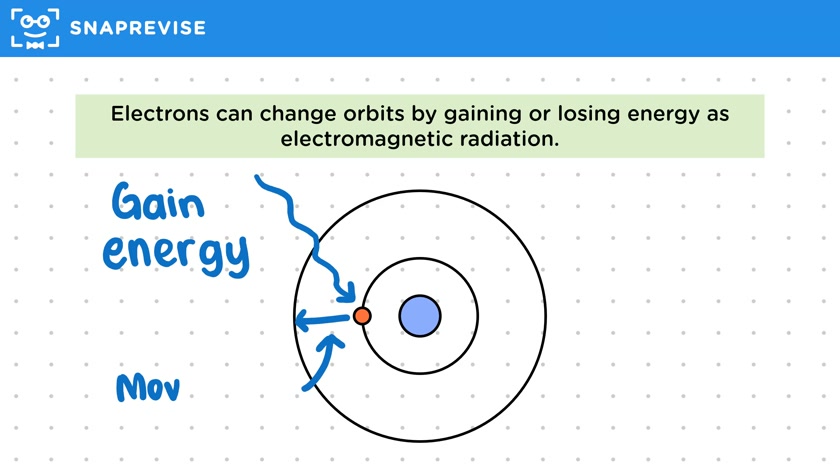
- Electrons can change orbits by gaining or losing energy through electromagnetic radiation.
- An electron moves to a higher orbit by absorbing the exact amount of energy needed from electromagnetic radiation.
- An electron can move to a lower orbit by releasing electromagnetic radiation.
- Theoretical calculations used by Boar to determine these energies matched experimental observations of radiation from hydrogen.
- Electromagnetic radiation's wavelength, which determines its energy, can be measured.
- Boar's Theory is supported by the properties matching calculations and the observation of only certain wavelengths of radiation from hydrogen.
- Boar's calculations were incorrect for larger atoms; the method used for hydrogen did not work for them.
- Despite inaccuracies for larger atoms, parts of Boar's Model are still applicable, such as fixed energy levels and emission of certain wavelengths.
- At the GCSE level, it is not required to know the details of electron arrangements in larger atoms, but Boar's model is assumed to still apply.
Please subscribe to access these revision notes.
This, and all other video notes, are included in our premium subscriptions.
Premium accounts get access to all videos and revision notes.
Report an Issue
Spotted something wrong? Let us know and we'll take a look.