
GCSE Biology (AQA)
331 videos | 14 hours
Please subscribe to watch this video.
This, and all other videos, are included in our premium subscriptions.
Premium accounts get access to all videos.
Enable autoplay to keep watching
Your browser is blocking videos from playing automatically. To turn it back on:
Safari (Mac): Click the Safari menu item in the top bar, then Settings → Websites → Auto-Play, then set Auto-Play to Allow All Auto-Play for the current website.
Safari (iPhone/iPad): open the Settings app, then Apps → Safari → Auto-Play, and select Allow All Auto-Play.
Cell Biology
Transport in Cells
Percentage Gain & Loss of Mass
4:47
Osmosis
Spec
4.1.3.2
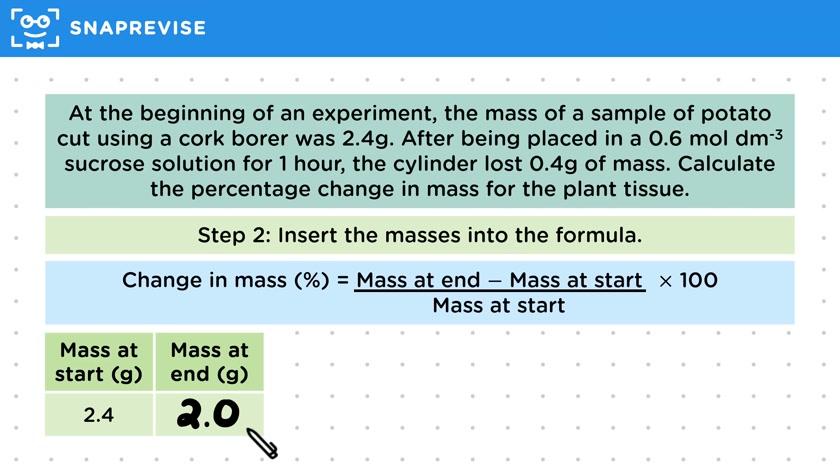
- Measure percentage gain and loss of massive plant tissue using a formula: (mass at end - mass at start) / mass at start * 100.
- Change in mass can be either positive or negative, indicating mass gain or loss.
- Memorize the formula for exams to measure percentage changes in plant tissue.
- Practical example using potato cylinders placed in different sucrose solution concentrations to observe changes due to osmosis.
- Initial mass of potato cylinder was 2.4 grams; after exposure to a 0.6 M sucrose solution for one hour, it lost 0.4 grams.
- Percentage change in mass calculated as -16.7%, indicating a loss in mass.
- Experiment repeated at various sucrose concentrations to gather comprehensive data on how mass changes with sucrose concentration.
- Positive values indicate water gain (increase in mass), negative values indicate water loss (decrease in mass).
- Graphical representation shows that as sucrose concentration increases, the change in mass generally decreases due to more water loss by osmosis.
- At certain sucrose concentrations (0.25 to 0.3 M), no net osmosis occurs, indicating isotonic conditions relative to potato cells.
- Ability to draw and interpret graphs of percentage gain or loss in mass against sucrose concentration is crucial for exams.
Please subscribe to access these revision notes.
This, and all other video notes, are included in our premium subscriptions.
Premium accounts get access to all videos and revision notes.
Report an Issue
Spotted something wrong? Let us know and we'll take a look.