
GCSE Biology (AQA)
331 videos | 14 hours
Please subscribe to watch this video.
This, and all other videos, are included in our premium subscriptions.
Premium accounts get access to all videos.
Enable autoplay to keep watching
Your browser is blocking videos from playing automatically. To turn it back on:
Safari (Mac): Click the Safari menu item in the top bar, then Settings → Websites → Auto-Play, then set Auto-Play to Allow All Auto-Play for the current website.
Safari (iPhone/iPad): open the Settings app, then Apps → Safari → Auto-Play, and select Allow All Auto-Play.
Cell Biology
Transport in Cells
Rate of Water Uptake
2:56
Osmosis
Spec
4.1.3.2
- Water uptake rate can be measured by osmosis in different concentrations using a calculation.
- The formula for water uptake in grams per hour is: mass change in grams multiplied by 60, divided by time in minutes.
- Simple compound measures like grams per hour are used to express the rate of water uptake.
- Example using a potato: cylinders are cut using a cork borer, weighed, placed in different concentrations of sugar or salt, observed for water uptake rates, and then reweighed.
- This practical experiment can be conducted at school or at home.
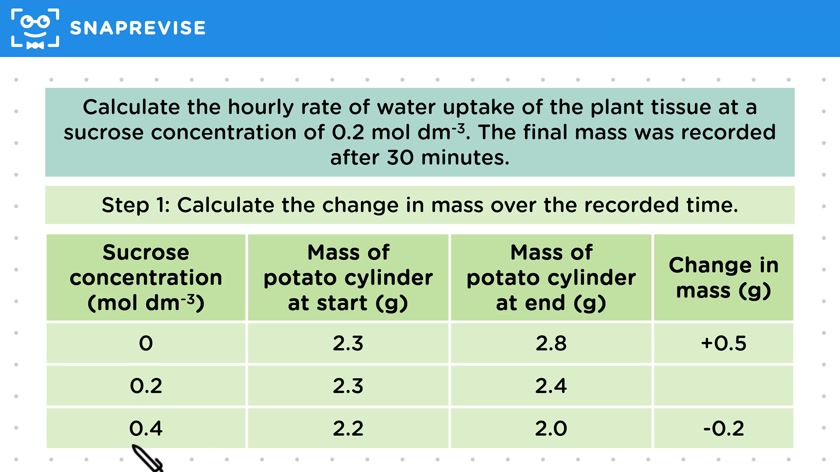
- To measure the rate of water uptake, calculate the hourly rate of water uptake of plant tissue at a specific sucrose concentration.
- Record the final mass after 30 minutes, calculate the change in mass over the recorded time.
- Positive change in mass indicates water absorption by the potato cylinder through osmosis from the surrounding solution.
- Higher values indicate more water absorbed by the plant tissue.
- Negative change in mass at higher sucrose concentrations indicates mass loss from the potato cylinder.
- Calculate the change in mass by subtracting the initial mass of the potato cylinder from the final mass.
- Insert values into the formula to calculate the hourly uptake.
- Ensure correct units (grams per hour) are used in calculations.
- It's important to be able to perform simple calculations to determine the rate of water uptake.
Please subscribe to access these revision notes.
This, and all other video notes, are included in our premium subscriptions.
Premium accounts get access to all videos and revision notes.
Report an Issue
Spotted something wrong? Let us know and we'll take a look.