
GCSE Biology (AQA)
331 videos | 14 hours
Please subscribe to watch this video.
This, and all other videos, are included in our premium subscriptions.
Premium accounts get access to all videos.
Enable autoplay to keep watching
Your browser is blocking videos from playing automatically. To turn it back on:
Safari (Mac): Click the Safari menu item in the top bar, then Settings → Websites → Auto-Play, then set Auto-Play to Allow All Auto-Play for the current website.
Safari (iPhone/iPad): open the Settings app, then Apps → Safari → Auto-Play, and select Allow All Auto-Play.
Cell Biology
Transport in Cells
Active Transport in the Gut
1:21
Active Transport
Spec
4.1.3.3
- Cells require some substances in large quantities, making diffusion insufficient.
- Glucose, essential for cell respiration, is an example of such a substance.
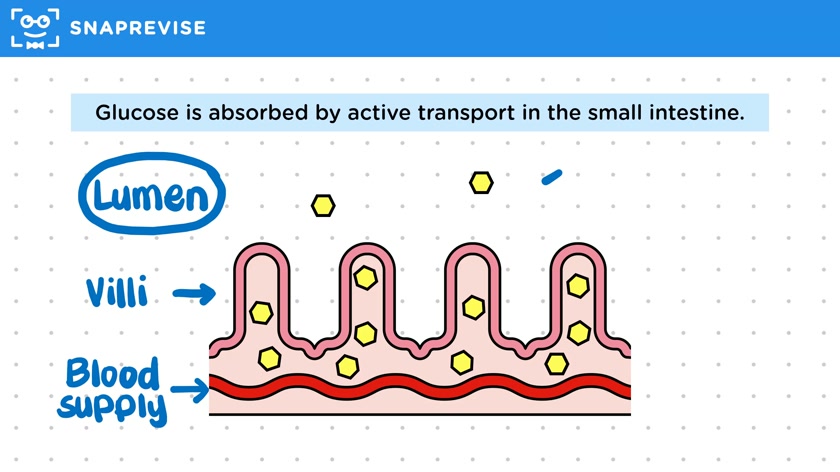
- Active transport is crucial for glucose absorption in the small intestine.
- The inner space of the intestine is called the lumen, with projections known as villi that are close to the blood supply.
- Post a sugary meal, glucose concentration might be higher in the lumen than in intestinal cells and blood, allowing diffusion down the concentration gradient.
- At times, glucose concentration in the lumen is lower than in cells, necessitating movement against the concentration gradient via active transport.
- Active transport, unlike diffusion and osmosis, requires energy, as it moves substances against the concentration gradient.
- Understanding the mechanism of sugar absorption by active transport in the gut is important for exams.
Please subscribe to access these revision notes.
This, and all other video notes, are included in our premium subscriptions.
Premium accounts get access to all videos and revision notes.
Report an Issue
Spotted something wrong? Let us know and we'll take a look.