
GCSE Physics (AQA)
346 videos | 23 hours
Please subscribe to watch this video.
This, and all other videos, are included in our premium subscriptions.
Premium accounts get access to all videos.
Enable autoplay to keep watching
Your browser is blocking videos from playing automatically. To turn it back on:
Safari (Mac): Click the Safari menu item in the top bar, then Settings → Websites → Auto-Play, then set Auto-Play to Allow All Auto-Play for the current website.
Safari (iPhone/iPad): open the Settings app, then Apps → Safari → Auto-Play, and select Allow All Auto-Play.
Magnetism and electromagnetism
Induced potential, transformers and the National Grid
The Transformer Equation
8:15
Transformers
Spec
4.7.3.4
- The potential difference between the input and output of a transformer depends on the number of windings in each coil.
- A transformer uses the generator effect to induce an output alternating current with a different potential difference.
- The difference in potential is determined by the number of windings on the secondary coil compared to the primary coil.
- More windings on the secondary coil result in a larger output potential difference.
- The transformer equation relates the ratio of potential differences to the ratio of turns in the coils: VP/VS = NP/NS.
- VP is the primary potential difference, VS is the secondary potential difference, NP is the number of turns in the primary coil, and NS is the number of turns in the secondary coil.
- For a step-up transformer, there are more turns on the secondary coil, increasing the input potential difference.
- Example: A step-up transformer with 4 turns on the primary coil and 8 on the secondary coil doubles the potential difference from 5 volts to 10 volts.
- For a step-down transformer, there are fewer turns on the secondary coil, decreasing the input potential difference.
- Example: A step-down transformer with 8 turns on the primary coil and 4 on the secondary coil halves the potential difference from 12 volts to 6 volts.
- Students should be able to use the transformer equation for calculations and explain transformer design.
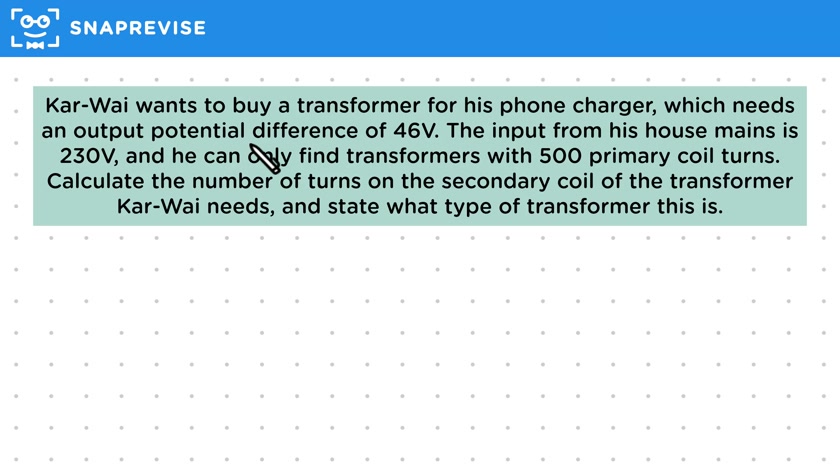
- Example problem: Calculate the number of turns on the secondary coil for a transformer with a primary potential difference of 230 volts, a secondary potential difference of 46 volts, and 500 primary coil turns.
- Solution involves rearranging the transformer equation to solve for NS and substituting the given values.
- The problem also requires identifying the type of transformer based on input and output potential differences.
- In the example, the transformer is a step-down type because the primary potential difference is greater than the secondary potential difference.
Please subscribe to access these revision notes.
This, and all other video notes, are included in our premium subscriptions.
Premium accounts get access to all videos and revision notes.
Report an Issue
Spotted something wrong? Let us know and we'll take a look.