
GCSE Physics (AQA)
346 videos | 23 hours
Please subscribe to watch this video.
This, and all other videos, are included in our premium subscriptions.
Premium accounts get access to all videos.
Enable autoplay to keep watching
Your browser is blocking videos from playing automatically. To turn it back on:
Safari (Mac): Click the Safari menu item in the top bar, then Settings → Websites → Auto-Play, then set Auto-Play to Allow All Auto-Play for the current website.
Safari (iPhone/iPad): open the Settings app, then Apps → Safari → Auto-Play, and select Allow All Auto-Play.
Forces
Forces and motion
Terminal Velocity-Time Graphs
4:36
Terminal Velocity
Spec
4.5.6.1.5
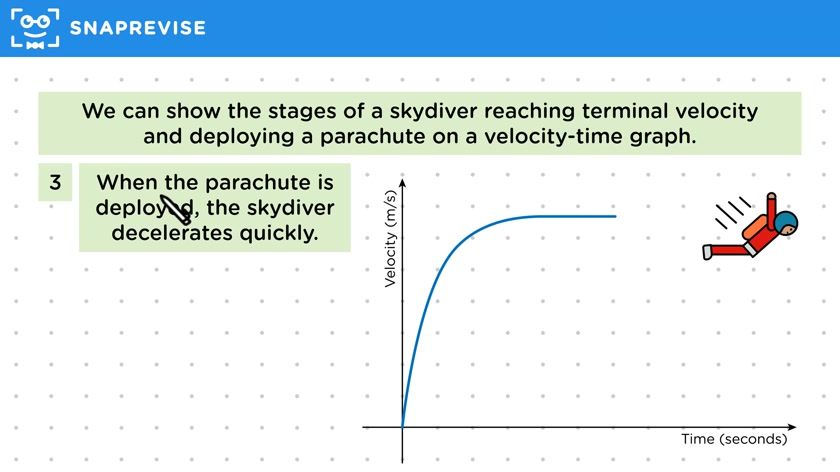
- Stages of a skydiver reaching terminal velocity and deploying a parachute can be shown on a velocity time graph.
- Terminal velocity is the constant speed when air resistance balances weight.
- Understanding velocity time graphs for various falling objects is necessary for exams.
- A skydiver's graph includes all components of other graphs in this topic.
- Velocity time graph: time on x-axis, velocity on y-axis.
- Initial acceleration downward due to weight being greater than air resistance.
- Positive gradient on graph as velocity increases, but gradient decreases over time as air resistance increases.
- Skydiver reaches constant terminal velocity when air resistance balances weight, shown as a horizontal line on the graph.
- Parachute deployment causes quick deceleration, increasing air resistance and resulting in an upward force.
- Negative gradient curve on graph as velocity decreases, leveling off as forces balance again.
- New lower terminal velocity reached, shown as a lower horizontal line on the graph.
- Sudden force changes, like a coin falling into water, show similar graph shapes.
- Skydiver landing causes a strong upward reaction force, bringing them to a stop.
- Parachute ensures final terminal velocity is low to minimize speed change upon landing.
- Nearly vertical line on graph from last section to x-axis where velocity is zero.
- In exams, you may need to complete missing graph sections or interpret graph parts related to motion of falling objects.
Please subscribe to access these revision notes.
This, and all other video notes, are included in our premium subscriptions.
Premium accounts get access to all videos and revision notes.
Report an Issue
Spotted something wrong? Let us know and we'll take a look.