
GCSE Physics (AQA)
346 videos | 23 hours
Please subscribe to watch this video.
This, and all other videos, are included in our premium subscriptions.
Premium accounts get access to all videos.
Enable autoplay to keep watching
Your browser is blocking videos from playing automatically. To turn it back on:
Safari (Mac): Click the Safari menu item in the top bar, then Settings → Websites → Auto-Play, then set Auto-Play to Allow All Auto-Play for the current website.
Safari (iPhone/iPad): open the Settings app, then Apps → Safari → Auto-Play, and select Allow All Auto-Play.
Forces
Forces and motion
Acceleration from Velocity-Time Graphs
3:51
Velocity-Time Graphs
Spec
4.5.6.1.5
- Acceleration of an object can be determined by calculating the gradient of its velocity-time graph.
- A velocity-time graph represents an object's motion, with the Y value as velocity and the X value as time.
- Calculating the gradient involves finding the difference in Y values (change in velocity) and dividing by the difference in X values (time taken).
- The gradient of a velocity-time graph is equal to the object's acceleration.
- For exams, remember to calculate the gradient to find acceleration from a velocity-time graph.
- Be careful not to confuse gradients of distance-time graphs with velocity-time graphs.
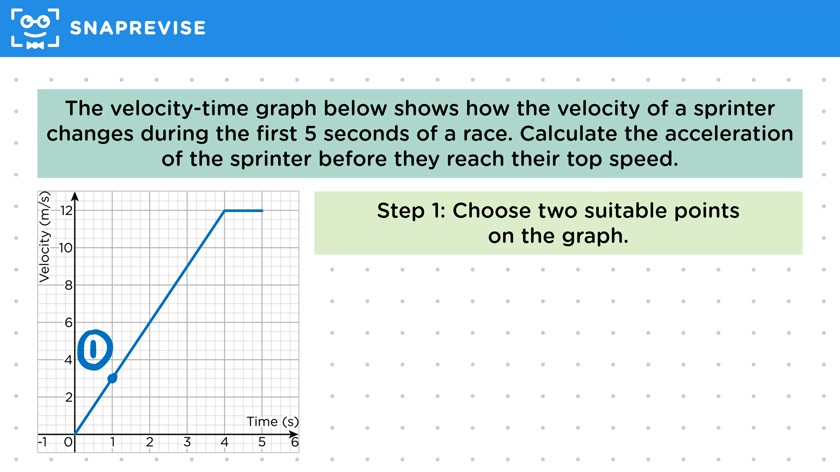
- Example: Calculate acceleration of a sprinter from a velocity-time graph during the first five seconds of a race.
- Step 1: Choose two suitable points on the graph that are easy to read and far apart.
- Example points: (3 m/s, 1 s) and (10.5 m/s, 3.5 s).
- Step 2: Find the difference in velocities (10.5 - 3 = 7.5 m/s).
- Step 3: Find the difference in times (3.5 - 1 = 2.5 s).
- Step 4: Divide the difference in velocity by the difference in time (7.5 / 2.5 = 3 m/s��).
- The acceleration is 3 meters per second squared.
- Units of acceleration are derived from the units of velocity and time on the graph labels.
Please subscribe to access these revision notes.
This, and all other video notes, are included in our premium subscriptions.
Premium accounts get access to all videos and revision notes.
Report an Issue
Spotted something wrong? Let us know and we'll take a look.