
GCSE Physics (AQA)
346 videos | 23 hours
Please subscribe to watch this video.
This, and all other videos, are included in our premium subscriptions.
Premium accounts get access to all videos.
Enable autoplay to keep watching
Your browser is blocking videos from playing automatically. To turn it back on:
Safari (Mac): Click the Safari menu item in the top bar, then Settings → Websites → Auto-Play, then set Auto-Play to Allow All Auto-Play for the current website.
Safari (iPhone/iPad): open the Settings app, then Apps → Safari → Auto-Play, and select Allow All Auto-Play.
Particle model of matter
Particle model and pressure
Kinetic Theory of a Gas
1:44
Gas Pressure and Kinetic Theory
Spec
4.3.3.1
- The kinetic theory of gas models the behavior of gas particles.
- It is a theoretical model since direct observation of gas particles is not possible.
- The theory explains most known observations of gases effectively.
- Gas particles are in constant random motion.
- Particles move in random directions and speeds, and they spread out.
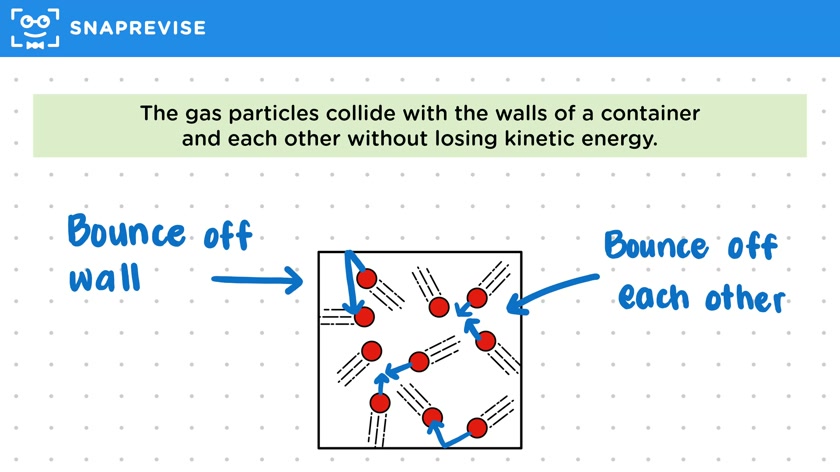
- Gas particles change direction due to collisions with container walls and other particles.
- Collisions with walls are more frequent than collisions between particles due to the small size and spread-out nature of the particles.
- Particles do not lose speed during collisions because no kinetic energy is transferred, maintaining the total kinetic energy of the system.
- A change in the total kinetic energy of the system can be caused by a change in temperature.
- Increasing the temperature raises the average kinetic energy and therefore the average speed of the particles.
- For exams, students should understand the kinetic theory of gas and how temperature changes affect the kinetic energy of particles.
- Temperature is described as a measure of the kinetic energy in the system.
Please subscribe to access these revision notes.
This, and all other video notes, are included in our premium subscriptions.
Premium accounts get access to all videos and revision notes.
Report an Issue
Spotted something wrong? Let us know and we'll take a look.