
GCSE Physics (AQA)
346 videos | 23 hours
Please subscribe to watch this video.
This, and all other videos, are included in our premium subscriptions.
Premium accounts get access to all videos.
Enable autoplay to keep watching
Your browser is blocking videos from playing automatically. To turn it back on:
Safari (Mac): Click the Safari menu item in the top bar, then Settings → Websites → Auto-Play, then set Auto-Play to Allow All Auto-Play for the current website.
Safari (iPhone/iPad): open the Settings app, then Apps → Safari → Auto-Play, and select Allow All Auto-Play.
Magnetism and electromagnetism
Induced potential, transformers and the National Grid
Factors Affecting an Induced Potential Difference
5:38
The Generator Effect
Spec
4.7.3.1
- The size and direction of potential difference and current induced by a magnetic field are influenced by various factors.
- A potential difference can be induced in a conductor by having it cut the field lines of a magnetic field.
- If the conductor is part of a circuit, this potential difference will cause a current to flow.
- Stronger magnetic fields induce larger potential differences.
- Using two identical conducting coils and different magnets results in different potential differences.
- A weak magnet with a weak field results in low potential difference and current.
- The current and potential difference of the coil are proportional to each other, assuming constant coil resistance.
- A stronger magnet with a stronger field through the coil results in a high potential difference and current.
- Faster movement induces larger potential differences.
- Moving the magnet slowly results in a low potential difference and current, while moving quickly results in a higher potential difference and current.
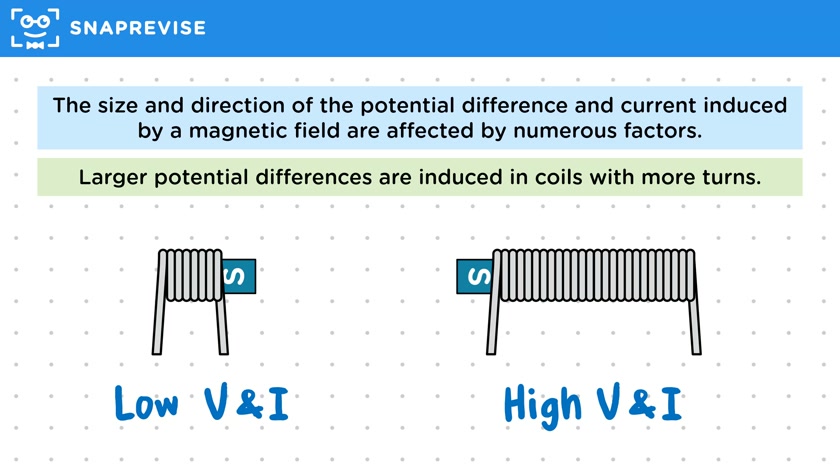
- Larger potential differences are induced in coils with more turns.
- Wrapping the coil more times results in a higher potential difference and current.
- Reversing the direction of motion reverses the potential difference.
- Using two magnetic poles and waving a conductor between them demonstrates potential difference direction change.
- Reversing the field direction also reverses the potential difference.
- Field lines always point from a north pole to a south pole.
- Factors affecting the size of induced potential difference and current include field strength, speed of motion, and number of coils.
- Reversing the direction of the field or motion reverses the potential difference and current.
Please subscribe to access these revision notes.
This, and all other video notes, are included in our premium subscriptions.
Premium accounts get access to all videos and revision notes.
Report an Issue
Spotted something wrong? Let us know and we'll take a look.