
GCSE Physics (AQA)
346 videos | 23 hours
Please subscribe to watch this video.
This, and all other videos, are included in our premium subscriptions.
Premium accounts get access to all videos.
Enable autoplay to keep watching
Your browser is blocking videos from playing automatically. To turn it back on:
Safari (Mac): Click the Safari menu item in the top bar, then Settings → Websites → Auto-Play, then set Auto-Play to Allow All Auto-Play for the current website.
Safari (iPhone/iPad): open the Settings app, then Apps → Safari → Auto-Play, and select Allow All Auto-Play.
Forces
Forces and motion
Distance & Displacement
3:14
Distance, Displacement and Speed
Spec
4.5.6.1.1
4.5.6.1.3
- Distance measures how far an object moves.
- Distance can be measured using tools like a ruler or measuring wheel.
- Distance is measured in meters, an SI unit.
- Originally, a meter was defined as one 10,000,000th the distance from the North Pole to the equator via Paris.
- Distance is a scalar quantity, meaning it has magnitude but no direction.
- Total distance can be found by adding individual parts together.
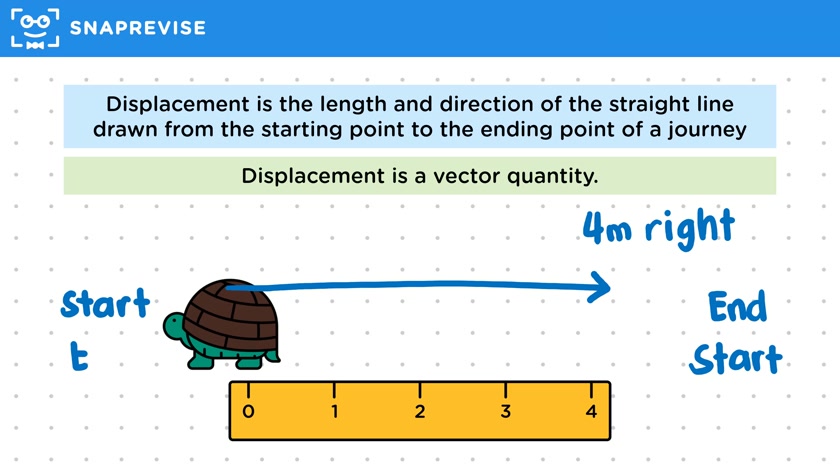
- Displacement is the length and direction of a straight line from the starting point to the ending point of a journey.
- Displacement is a vector quantity, meaning it has both magnitude and direction.
- Displacement can be represented by arrows from start to end points.
- Displacement is expressed in terms of magnitude and direction.
- The magnitude of displacement is always less than or equal to the distance traveled.
- Distances always add as they are scalars, while displacements add and subtract as they are vectors.
- Displacement describes only the start and end points, whereas distance describes the full journey.
- For exams, understanding the differences between distance and displacement is important.
Please subscribe to access these revision notes.
This, and all other video notes, are included in our premium subscriptions.
Premium accounts get access to all videos and revision notes.
Report an Issue
Spotted something wrong? Let us know and we'll take a look.