
GCSE Physics (AQA)
346 videos | 23 hours
Please subscribe to watch this video.
This, and all other videos, are included in our premium subscriptions.
Premium accounts get access to all videos.
Enable autoplay to keep watching
Your browser is blocking videos from playing automatically. To turn it back on:
Safari (Mac): Click the Safari menu item in the top bar, then Settings → Websites → Auto-Play, then set Auto-Play to Allow All Auto-Play for the current website.
Safari (iPhone/iPad): open the Settings app, then Apps → Safari → Auto-Play, and select Allow All Auto-Play.
Forces
Momentum
Colliding & Sticking Calculations
7:57
Using the Conservation of Momentum
Spec
4.5.7.2
- When two objects stick and move together, they can be treated as a single object with combined mass.
- Momentum is the product of mass and velocity and remains constant in a closed system.
- Total momentum before a collision equals total momentum after a collision.
- Given velocities and masses before and after a collision, missing information like post-collision velocity can be calculated.
- Example: Two balls with masses M1 and M2, velocities U1 and U2, stick together after a collision.
- Velocity and momentum are vectors; consider direction (positive or negative).
- Total momentum is M1U1 + M2U2 before collision and (M1 + M2)V after collision.
- Use conservation of momentum to solve for unknowns.
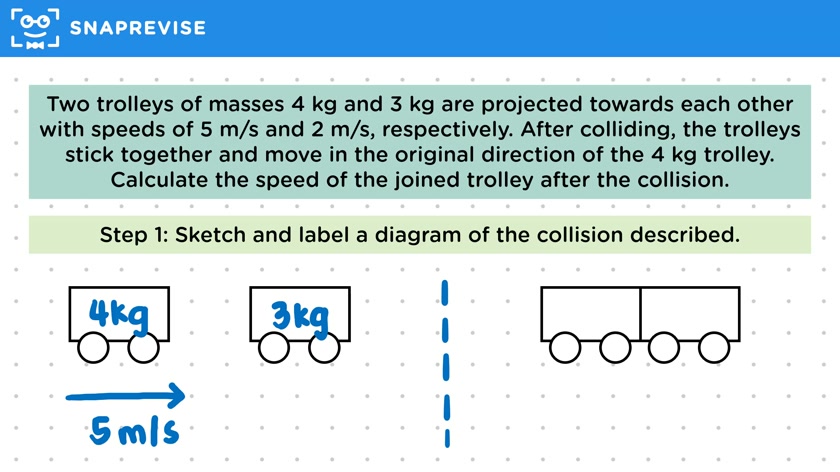
- Example problem: Two trolleys, 4 kg and 3 kg, with speeds 5 m/s and 2 m/s, collide and stick together.
- Calculate speed of joined trolley using conservation of momentum.
- Steps: Sketch diagram, calculate total momentum before collision, use conservation principle, calculate joined mass, rearrange momentum equation, calculate speed.
- Final speed of joined trolley is 2 m/s.
Please subscribe to access these revision notes.
This, and all other video notes, are included in our premium subscriptions.
Premium accounts get access to all videos and revision notes.
Report an Issue
Spotted something wrong? Let us know and we'll take a look.