
GCSE Maths (Edexcel)
435 videos | 33 hours
Please subscribe to watch this video.
This, and all other videos, are included in our premium subscriptions.
Premium accounts get access to all videos.
Enable autoplay to keep watching
Your browser is blocking videos from playing automatically. To turn it back on:
Safari (Mac): Click the Safari menu item in the top bar, then Settings → Websites → Auto-Play, then set Auto-Play to Allow All Auto-Play for the current website.
Safari (iPhone/iPad): open the Settings app, then Apps → Safari → Auto-Play, and select Allow All Auto-Play.
Geometry and Measures
Vectors
Splitting Vectors
7:06
Vector Problem Solving
Spec
R5
G25
- Vectors can be split into smaller vectors
- Vector A can be split into vectors B and C
- The sum of the smaller vectors equals the original vector
- Vectors are added by joining them head to tail
- Vector B and C, when joined head to tail, equal vector A
- Smaller vectors can be expressed as scalar multiples of the original vector
- B is equal to K times A, C is equal to L times A
- K and L represent the scalar multipliers of A
- The magnitude ratio of B to C can help determine K and L
- K plus L equals 1
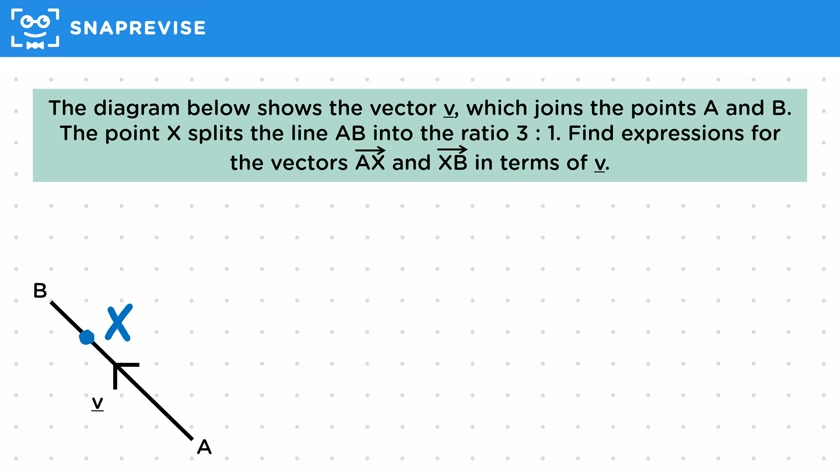
- Example problem: vector V is split into vectors A to X and X to B
- A to X equals K times V, X to B equals L times V
- V equals A to X plus X to B
- The ratio of K to L is given as 3 to 1
- 3L equals K
- K equals 3/4, L equals 1/4
- Final expressions for the split vectors: AX equals 3/4 V, XB equals 1/4 V
Please subscribe to access these revision notes.
This, and all other video notes, are included in our premium subscriptions.
Premium accounts get access to all videos and revision notes.
Report an Issue
Spotted something wrong? Let us know and we'll take a look.