
GCSE Maths (Edexcel)
435 videos | 33 hours
Please subscribe to watch this video.
This, and all other videos, are included in our premium subscriptions.
Premium accounts get access to all videos.
Enable autoplay to keep watching
Your browser is blocking videos from playing automatically. To turn it back on:
Safari (Mac): Click the Safari menu item in the top bar, then Settings → Websites → Auto-Play, then set Auto-Play to Allow All Auto-Play for the current website.
Safari (iPhone/iPad): open the Settings app, then Apps → Safari → Auto-Play, and select Allow All Auto-Play.
Ratio, Proportion and Rates of Change
Ratio, Proportion and Rates of Change
Growth & Decay as an Iterative Process
5:53
Growth & Decay
Spec
R16
- Growth and decay can be described as iterative processes
- Growth and decay describe when a value increases or decreases over a number of time periods
- Growth and decay can be modeled using an iterative equation
- The equation for growth is Pn plus 1 = Pn times 1.1 (representing a 10% increase)
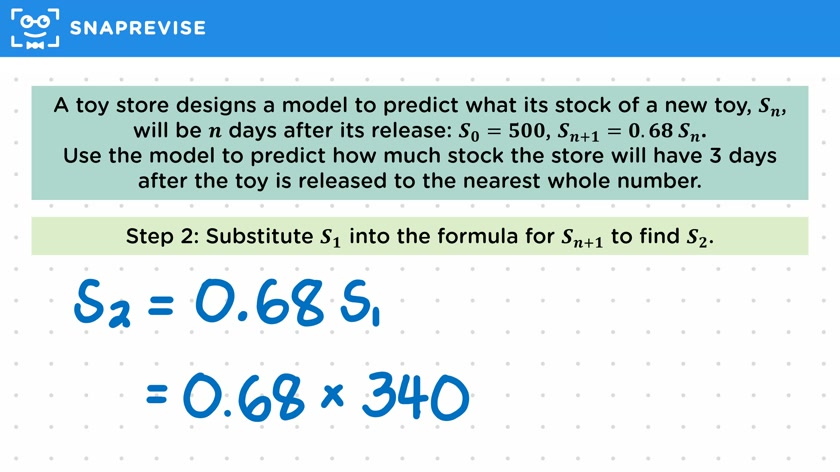
- The equation for decay is Sn plus 1 = 0.68 Sn
- Iterative equations for growth and decay are usually given in exam questions
- Example 1: Toy store stock prediction - S0 = 500, Sn plus 1 = 0.68 Sn
- Example 2: Sparrow population prediction - Sn plus 1 = 1.2 Sn minus 5
- In both examples, substitute the given values into the equation to find the predicted value for a specific time period
- Round the predicted value to the nearest whole number
Please subscribe to access these revision notes.
This, and all other video notes, are included in our premium subscriptions.
Premium accounts get access to all videos and revision notes.
Report an Issue
Spotted something wrong? Let us know and we'll take a look.