
GCSE Maths (AQA)
435 videos | 33 hours
Please subscribe to watch this video.
This, and all other videos, are included in our premium subscriptions.
Premium accounts get access to all videos.
Enable autoplay to keep watching
Your browser is blocking videos from playing automatically. To turn it back on:
Safari (Mac): Click the Safari menu item in the top bar, then Settings → Websites → Auto-Play, then set Auto-Play to Allow All Auto-Play for the current website.
Safari (iPhone/iPad): open the Settings app, then Apps → Safari → Auto-Play, and select Allow All Auto-Play.
Probability
Probability
Reliable Relative Frequencies
6:39
Relative Frequency
Spec
P1
P3
P5
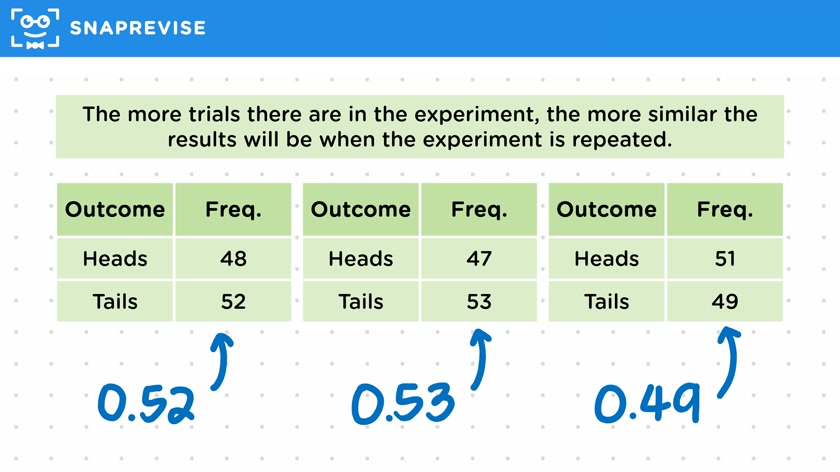
- The results of a probability experiment will change each time it is performed
- The relative frequencies calculated from each experiment will also change
- The more trials there are in an experiment, the more similar the results will be when the experiment is repeated
- The probability of a random outcome doesn't change depending on previous outcomes
- The more trials there are in an experiment, the closer the relative frequency will be to the true probability
- The more trials we perform in a probability experiment, the less deviation is expected from the true theoretical probability
- Experiments with more trials have frequencies that are closer to their expected frequencies
- The expected frequency is calculated by multiplying the number of trials by the theoretical probability of the outcome
Please subscribe to access these revision notes.
This, and all other video notes, are included in our premium subscriptions.
Premium accounts get access to all videos and revision notes.
Report an Issue
Spotted something wrong? Let us know and we'll take a look.