
GCSE Combined Science (AQA)
622 videos | 38 hours
Please subscribe to watch this video.
This, and all other videos, are included in our premium subscriptions.
Premium accounts get access to all videos.
Enable autoplay to keep watching
Your browser is blocking videos from playing automatically. To turn it back on:
Safari (Mac): Click the Safari menu item in the top bar, then Settings → Websites → Auto-Play, then set Auto-Play to Allow All Auto-Play for the current website.
Safari (iPhone/iPad): open the Settings app, then Apps → Safari → Auto-Play, and select Allow All Auto-Play.
Chemistry of the atmosphere
The composition and evolution of the Earth's atmosphere
The Early Atmosphere: Oxygen
2:30
Changes in Earth's Atmosphere Over Time
Spec
4.9.1.3
- The Earth's early atmosphere had little or no oxygen.
- Earth is about 4.6 billion years old.
- Early atmosphere was mostly carbon dioxide with some nitrogen and water vapor due to volcanic eruptions.
- Water vapor condensed to form oceans, reducing carbon dioxide and increasing oxygen in the atmosphere.
- Algae and plants produced the oxygen present in the atmosphere today.
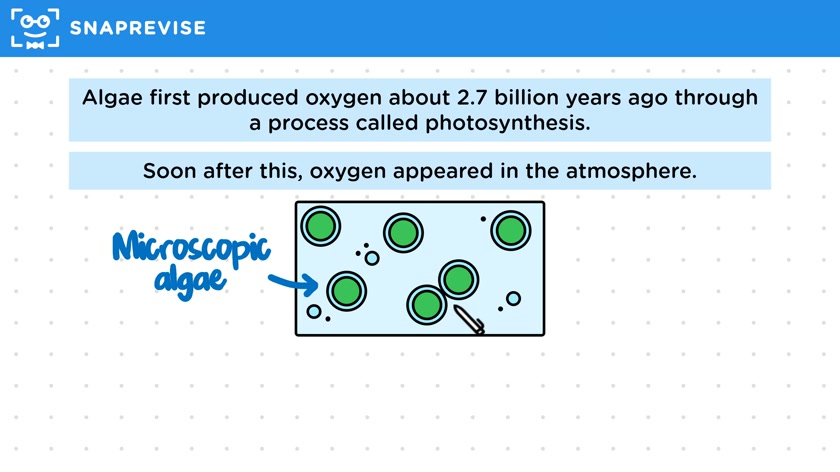
- Algae first produced oxygen about 2.7 billion years ago through photosynthesis.
- Cyanobacteria were among the first organisms to photosynthesize and were early life forms on Earth.
- Photosynthesis equation: Carbon dioxide + water + light ��� glucose + oxygen.
- Symbol equation: 6 CO2 + 6 H2O ��� C6H12O6 + 6 O2.
- Light is essential for photosynthesis, driving the endothermic reaction that produces glucose.
- Over a billion years, plants evolved, increasing atmospheric oxygen.
- More complex life forms evolved as oxygen levels increased.
- More plants led to more photosynthesis, further increasing atmospheric oxygen.
- Oxygen levels eventually enabled animal evolution.
Please subscribe to access these revision notes.
This, and all other video notes, are included in our premium subscriptions.
Premium accounts get access to all videos and revision notes.
Report an Issue
Spotted something wrong? Let us know and we'll take a look.