
GCSE Combined Science (AQA)
622 videos | 38 hours
Please subscribe to watch this video.
This, and all other videos, are included in our premium subscriptions.
Premium accounts get access to all videos.
Enable autoplay to keep watching
Your browser is blocking videos from playing automatically. To turn it back on:
Safari (Mac): Click the Safari menu item in the top bar, then Settings → Websites → Auto-Play, then set Auto-Play to Allow All Auto-Play for the current website.
Safari (iPhone/iPad): open the Settings app, then Apps → Safari → Auto-Play, and select Allow All Auto-Play.
Chemical analysis
Purity, formulations and chromatography
Purity: Melting & Boiling Points
3:11
Identifying Pure Substances and Mixtures
Spec
4.8.1.1
- Everyday language defines a substance as pure if nothing is added and it is in its natural state.
- Example: Orange juice made only from oranges is considered 100% pure.
- Pure in chemistry means a single element or compound not mixed with any other substance.
- Pure gold is an example of a pure substance, consisting only of gold atoms.
- Pure water contains only water molecules; drinking water is not pure due to minerals like calcium, potassium, and zinc.
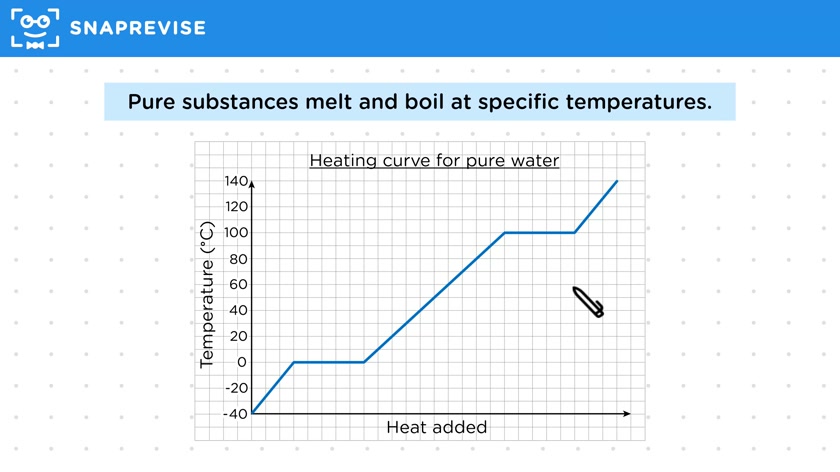
- Pure substances melt and boil at specific temperatures, shown by flat sections on a heating curve graph.
- Impure substances melt and boil over a range of temperatures, lacking flat sections on a graph.
- Melting and boiling point data can distinguish pure substances from mixtures.
- A pure substance's graph has horizontal lines during changes of state, while an impure substance's graph does not.
Please subscribe to access these revision notes.
This, and all other video notes, are included in our premium subscriptions.
Premium accounts get access to all videos and revision notes.
Report an Issue
Spotted something wrong? Let us know and we'll take a look.