
GCSE Combined Science (AQA)
622 videos | 38 hours
Please subscribe to watch this video.
This, and all other videos, are included in our premium subscriptions.
Premium accounts get access to all videos.
Enable autoplay to keep watching
Your browser is blocking videos from playing automatically. To turn it back on:
Safari (Mac): Click the Safari menu item in the top bar, then Settings → Websites → Auto-Play, then set Auto-Play to Allow All Auto-Play for the current website.
Safari (iPhone/iPad): open the Settings app, then Apps → Safari → Auto-Play, and select Allow All Auto-Play.
Magnetism and electromagnetism
Permanent and induced magnetism, magnetic forces and fields
Magnetic Field Strength
3:16
Introduction to Magnetic Fields
Spec
4.7.1.2
- Magnetic objects experience a force in the magnetic field around a magnet.
- A bar magnet and a steel screw are examples of a magnet and a magnetic object.
- The screw becomes an induced magnet with a north pole facing the bar magnet's south pole.
- Unlike poles cause the screw to experience an attractive force towards the magnet.
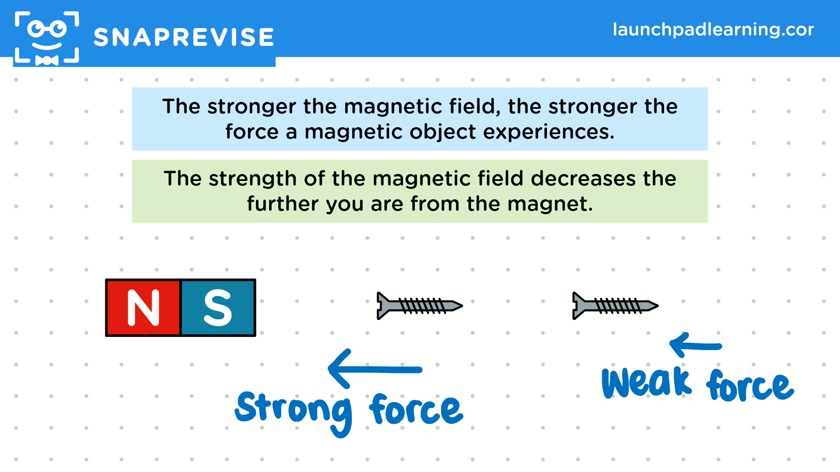
- The strength of the magnetic field affects the force experienced by a magnetic object.
- The magnetic field strength decreases with distance from the magnet.
- A screw far from the magnet experiences a weak force and moves slowly towards it.
- A screw close to the magnet experiences a strong force and moves quickly towards it.
- Field strength is maximum at the poles where field lines are closest.
- Magnetic field lines indicate the direction of force on a north pole in the field.
- A compass can trace out field lines for a bar magnet.
- Field lines start at the north pole and finish at the south pole.
- Closer field lines indicate stronger magnetic forces.
- Field lines are denser near the poles, indicating a strong field.
- Field lines are sparse away from the poles, indicating a weak field.
- For exams, be able to draw field line patterns for a bar magnet and explain field strength variations.
Please subscribe to access these revision notes.
This, and all other video notes, are included in our premium subscriptions.
Premium accounts get access to all videos and revision notes.
Report an Issue
Spotted something wrong? Let us know and we'll take a look.