
GCSE Combined Science (AQA)
622 videos | 38 hours
Please subscribe to watch this video.
This, and all other videos, are included in our premium subscriptions.
Premium accounts get access to all videos.
Enable autoplay to keep watching
Your browser is blocking videos from playing automatically. To turn it back on:
Safari (Mac): Click the Safari menu item in the top bar, then Settings → Websites → Auto-Play, then set Auto-Play to Allow All Auto-Play for the current website.
Safari (iPhone/iPad): open the Settings app, then Apps → Safari → Auto-Play, and select Allow All Auto-Play.
Chemical changes
Reactions of acids
Forming Soluble salts
6:31
pH and Neutralisation Reactions
Spec
4.4.2.3
- Soluble salts can be made by reacting solid insoluble substances with acids.
- Salts are compounds made up of a positive and a negative ion.
- Typically produced by reacting acids with alkalis, but other insoluble substances like metals, metal oxides, hydroxides, and carbonates can be used.
- Pure metals are not usually used due to violent or slow reactions with acids.
- Metal compounds are preferred for making salts.
- Example: To make copper salt, use copper oxide, copper hydroxide, or copper carbonate.
- The type of salt produced depends on the positive ions from the metal and the negative ions from the acid.
- Steps to make a pure dry sample of a specific soluble salt:
- 1. Identify the reactants needed (e.g., copper oxide and sulfuric acid for copper sulfate).
- 2. Add the insoluble solid to the acid in excess to ensure all the acid is used up.
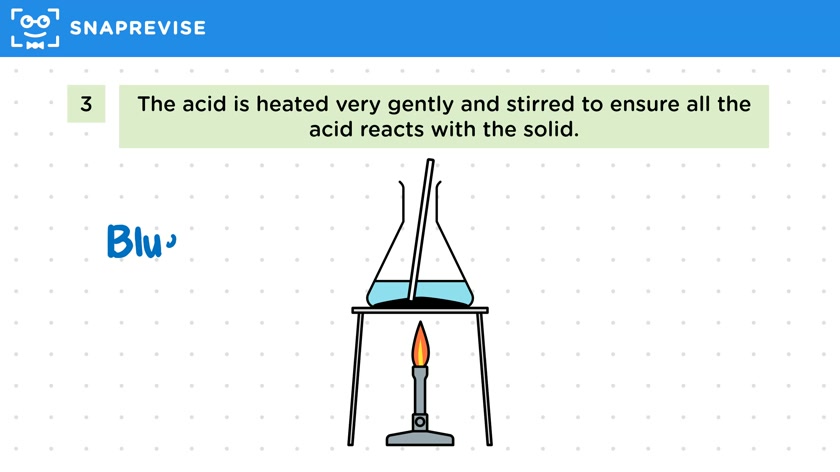
- 3. Heat and stir the acid gently to react with the solid completely.
- 4. Filter the solution to remove excess solid and leave a pure salt solution.
- 5. Evaporate the water to crystallize the salt using an evaporating basin.
- 6. Turn off the heat when crystals form and let the rest of the water evaporate naturally.
- 7. Dab the crystals between filter paper to remove excess solution and leave them to dry.
Please subscribe to access these revision notes.
This, and all other video notes, are included in our premium subscriptions.
Premium accounts get access to all videos and revision notes.
Report an Issue
Spotted something wrong? Let us know and we'll take a look.