
GCSE Combined Science (AQA)
622 videos | 38 hours
Please subscribe to watch this video.
This, and all other videos, are included in our premium subscriptions.
Premium accounts get access to all videos.
Enable autoplay to keep watching
Your browser is blocking videos from playing automatically. To turn it back on:
Safari (Mac): Click the Safari menu item in the top bar, then Settings → Websites → Auto-Play, then set Auto-Play to Allow All Auto-Play for the current website.
Safari (iPhone/iPad): open the Settings app, then Apps → Safari → Auto-Play, and select Allow All Auto-Play.
Atomic structure
Atoms and isotopes
Electrons
2:25
Atomic Structure
Spec
4.4.1.1
- Electrons are negatively charged particles that orbit the nucleus of an atom.
- Electrons have a negative charge equal and opposite to protons, specifically minus 1.6 times 10 to the minus 19 kloss.
- Electrons are very small compared to protons and neutrons, with an electron being 1/1000th the mass of protons or neutrons.
- Most of the atom's mass is in the nucleus.
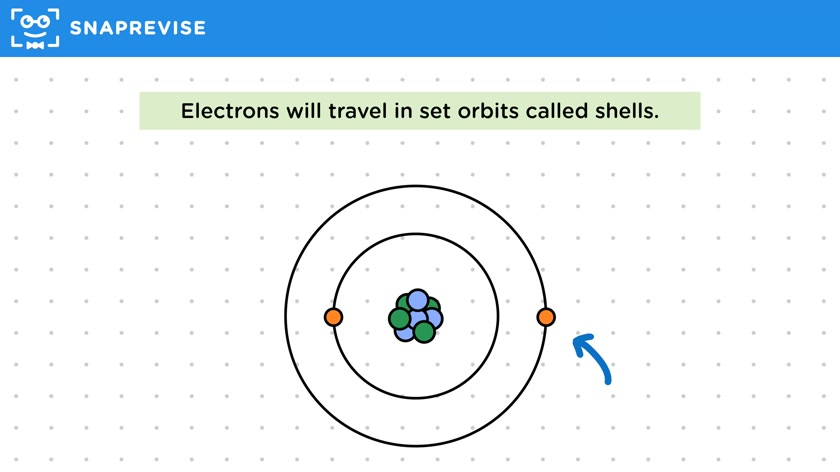
- Electrons travel in set orbits called shells, which are at set distances from the atom.
- The number of electrons in each orbit depends on the energy of the electrons.
- The distance between the nucleus and the first shell is about 10 to the minus 10 meters, but this is not required knowledge for exams.
- The distance between successive shells is not constant.
- Electrons can change shells by absorbing or emitting electromagnetic radiation, such as visible light and infrared.
- Electrons move up a shell by gaining energy from radiation, with the energy gained needing to be exactly the amount required to bridge the gap between energy levels.
- Electrons can drop down a shell by releasing excess energy as radiation when there is room in a lower shell.
Please subscribe to access these revision notes.
This, and all other video notes, are included in our premium subscriptions.
Premium accounts get access to all videos and revision notes.
Report an Issue
Spotted something wrong? Let us know and we'll take a look.