
GCSE Combined Science (AQA)
622 videos | 38 hours
Please subscribe to watch this video.
This, and all other videos, are included in our premium subscriptions.
Premium accounts get access to all videos.
Enable autoplay to keep watching
Your browser is blocking videos from playing automatically. To turn it back on:
Safari (Mac): Click the Safari menu item in the top bar, then Settings → Websites → Auto-Play, then set Auto-Play to Allow All Auto-Play for the current website.
Safari (iPhone/iPad): open the Settings app, then Apps → Safari → Auto-Play, and select Allow All Auto-Play.
Atomic structure
Atoms and isotopes
Atomic Number
2:06
Atomic Structure
Spec
4.4.1.2
- The atomic number of an atom equals the number of protons in its nucleus.
- Protons are represented by blue circles with plus signs in diagrams.
- A nucleus with four protons has an atomic number of four.
- Neutrons are depicted as plain green circles.
- Atomic number is crucial for categorizing atoms.
- Atoms of the same element have the same atomic number.
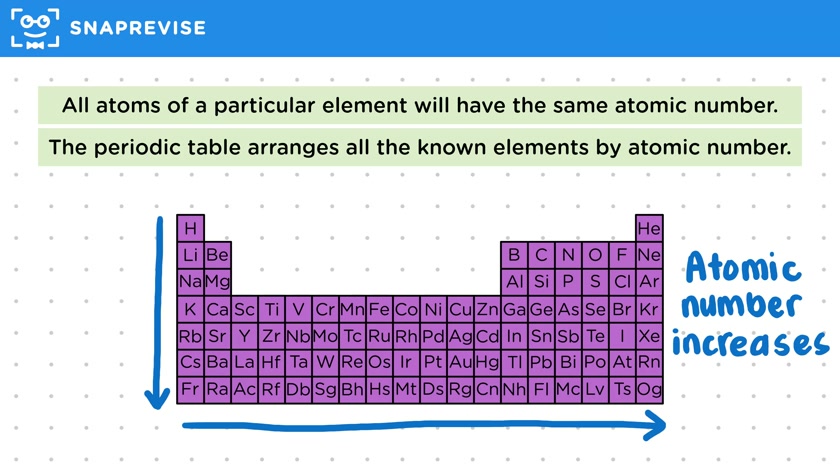
- The periodic table arranges elements by atomic number.
- Atomic number increases as you read down rows and along columns in the periodic table.
- The periodic table is a reference for atomic properties, not detailed physics use.
- Atoms of the same element have the same number of electrons as protons.
- Electrons orbit the nucleus in shells.
- The atomic number determines an element's chemical properties.
- Chemical properties involve electron interactions forming chemical bonds.
- Atomic notation uses the bottom number to represent the atomic number.
- Elements are written with a letter symbol and numbers to the left, above, and below.
- The atomic number is the bottom number in atomic notation.
- The letters indicate the element type.
- Beryllium is the only element with four protons in its nucleus.
Please subscribe to access these revision notes.
This, and all other video notes, are included in our premium subscriptions.
Premium accounts get access to all videos and revision notes.
Report an Issue
Spotted something wrong? Let us know and we'll take a look.