
GCSE Combined Science (AQA)
622 videos | 38 hours
Please subscribe to watch this video.
This, and all other videos, are included in our premium subscriptions.
Premium accounts get access to all videos.
Enable autoplay to keep watching
Your browser is blocking videos from playing automatically. To turn it back on:
Safari (Mac): Click the Safari menu item in the top bar, then Settings → Websites → Auto-Play, then set Auto-Play to Allow All Auto-Play for the current website.
Safari (iPhone/iPad): open the Settings app, then Apps → Safari → Auto-Play, and select Allow All Auto-Play.
Chemical changes
Electrolysis
Electrolysis of Solutions
9:59
Electrolysis of Ionic Compounds and Aluminium Extraction
Spec
4.4.3.4
- Water molecules can break down into hydrogen ions (H+) and hydroxide ions (OH-).
- Electrolysis involves separating positive and negative ions in a compound to convert them into atoms or molecules.
- In electrolysis, two conducting electrodes are submerged in an ionic solution or molten compound to create a circuit.
- The positive anode loses electrons, while the negative cathode gains electrons.
- During electrolysis, H+ ions travel to the negative cathode, and OH- ions travel to the positive anode due to opposite charges attracting.
- All ions, including hydrogen and hydroxide ions, must be considered in the electrolysis of an aqueous solution like sodium chloride.
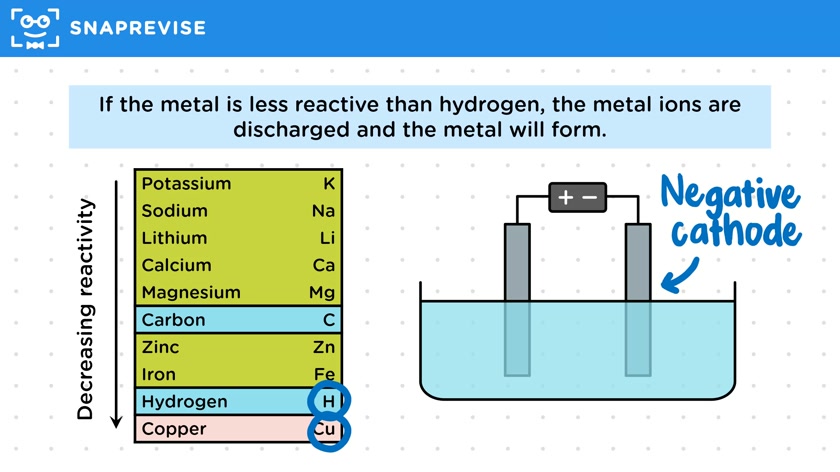
- At the cathode, either hydrogen ions or metal ions can be discharged depending on their reactivity.
- The reactivity series helps determine which ions are discharged; metals more reactive than hydrogen will not be discharged.
- Sodium is more reactive than hydrogen, so hydrogen ions are discharged at the cathode, forming H2 gas.
- Copper is less reactive than hydrogen, so copper ions are discharged at the cathode, forming copper metal.
- At the anode, if halide ions are present, they are discharged, producing halogen gas.
- If no halide ions are present, hydroxide ions are discharged, producing oxygen gas.
- In the electrolysis of copper sulfate solution, copper metal forms at the cathode, and oxygen forms at the anode.
Please subscribe to access these revision notes.
This, and all other video notes, are included in our premium subscriptions.
Premium accounts get access to all videos and revision notes.
Report an Issue
Spotted something wrong? Let us know and we'll take a look.