
GCSE Combined Science (AQA)
622 videos | 38 hours
Please subscribe to watch this video.
This, and all other videos, are included in our premium subscriptions.
Premium accounts get access to all videos.
Enable autoplay to keep watching
Your browser is blocking videos from playing automatically. To turn it back on:
Safari (Mac): Click the Safari menu item in the top bar, then Settings → Websites → Auto-Play, then set Auto-Play to Allow All Auto-Play for the current website.
Safari (iPhone/iPad): open the Settings app, then Apps → Safari → Auto-Play, and select Allow All Auto-Play.
Bonding, structure, and the properties of matter
Structure and bonding of carbon
Carbon Nanotubes
2:30
Carbon Structures and Bonding
Spec
4.2.3.3
- Carbon nanotubes are a type of rine, molecules made of carbon atoms with a hollow shape.
- They can be visualized as a layer of graphene rolled into a hollow cylindrical shape.
- Carbon nanotubes have very high length to diameter ratios, up to 28 million to one.
- Diameters can be as small as 0.4 nanometers, with lengths ranging from a few nanometers to a millimeter.
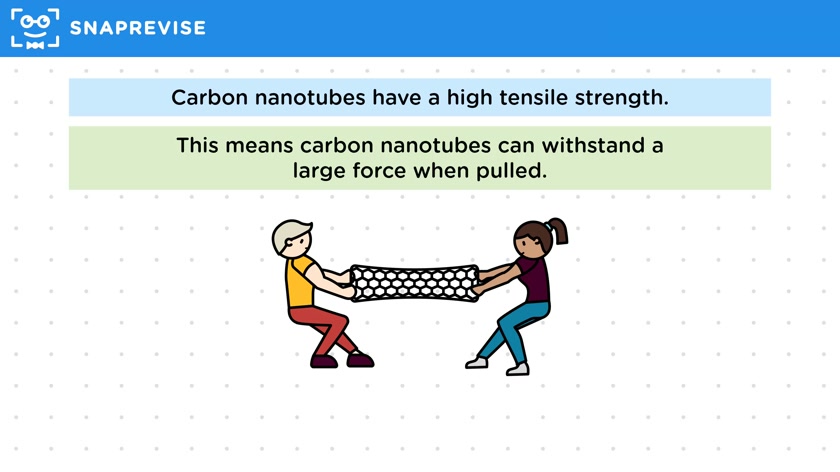
- They have high tensile strength, meaning they can withstand large forces when pulled due to strong covalent bonds.
- Carbon nanotubes are 100 times stronger than steel.
- They conduct electricity due to delocalized electrons that are free to move through the structure.
- Uses include materials, electronics, and nanotechnology.
- They are used in modern electronics, such as rechargeable lithium-ion batteries for cars and potentially new touchscreen technologies.
Please subscribe to access these revision notes.
This, and all other video notes, are included in our premium subscriptions.
Premium accounts get access to all videos and revision notes.
Report an Issue
Spotted something wrong? Let us know and we'll take a look.