
GCSE Combined Science (AQA)
622 videos | 38 hours
Please subscribe to watch this video.
This, and all other videos, are included in our premium subscriptions.
Premium accounts get access to all videos.
Enable autoplay to keep watching
Your browser is blocking videos from playing automatically. To turn it back on:
Safari (Mac): Click the Safari menu item in the top bar, then Settings → Websites → Auto-Play, then set Auto-Play to Allow All Auto-Play for the current website.
Safari (iPhone/iPad): open the Settings app, then Apps → Safari → Auto-Play, and select Allow All Auto-Play.
Particle model of matter
Internal energy and energy transfers
Calculating Energy to Change State
3:04
Heating to Change State
Spec
4.3.2.3
- Energy change for a change in state depends on mass and specific latent heat.
- Specific latent heat is the energy required to change the state of 1 kg of a substance without a temperature change.
- Thermal energy needed for change = mass x specific latent heat (E = M x L).
- Energy is measured in joules, mass in kilograms, and specific latent heat in joules per kilogram.
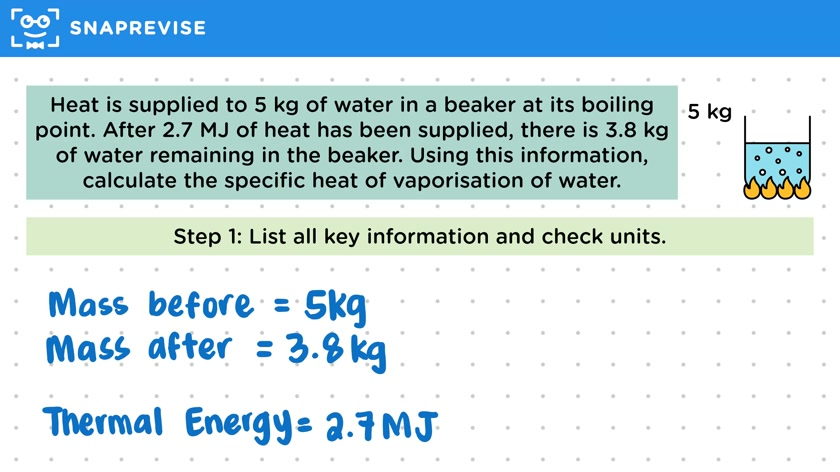
- Example: Heat supplied to 5 kg of water at boiling point; 2.7 megajoules of heat supplied, 3.8 kg of water remains.
- Calculate specific heat of vaporization of water.
- Convert 2.7 megajoules to 2,700,000 joules.
- Determine mass of water boiled: 5 kg - 3.8 kg = 1.2 kg.
- Rearrange equation to make specific latent heat the subject: specific latent heat = thermal energy / mass.
- Substitute values: specific latent heat = 2,700,000 joules / 1.2 kg = 2,250,000 joules per kilogram.
- Answer can also be expressed as 2.25 megajoules per kilogram or 2.25 x 10^6 joules per kilogram.
Please subscribe to access these revision notes.
This, and all other video notes, are included in our premium subscriptions.
Premium accounts get access to all videos and revision notes.
Report an Issue
Spotted something wrong? Let us know and we'll take a look.