
GCSE Chemistry (AQA)
196 videos | 19 hours
Please subscribe to watch this video.
This, and all other videos, are included in our premium subscriptions.
Premium accounts get access to all videos.
Enable autoplay to keep watching
Your browser is blocking videos from playing automatically. To turn it back on:
Safari (Mac): Click the Safari menu item in the top bar, then Settings → Websites → Auto-Play, then set Auto-Play to Allow All Auto-Play for the current website.
Safari (iPhone/iPad): open the Settings app, then Apps → Safari → Auto-Play, and select Allow All Auto-Play.
Atomic structure and the periodic table
Properties of transition metals
Transition Elements: Physical Properties
3:19
Transition Element Properties and Compounds
Spec
4.1.3.1
- Transition elements are located in the central part of the periodic table.
- Transition elements are all metals, also known as transition metals.
- Transition metals form the majority of all metals on the periodic table.
- Transition metals are stronger, denser, and harder than group one metals (alkaline metals).
- Alkaline metals are soft and can be cut with a knife; they are not very dense and can float on water.
- Transition metals are useful for making dense and hard objects like training weights, construction materials, and machinery.
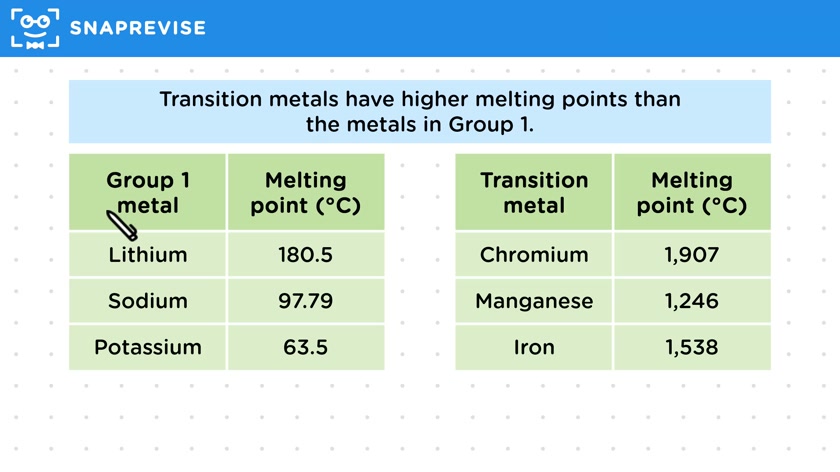
- Transition metals have higher melting points than group one metals.
- Alkaline metals have relatively low melting points, while transition metals have high melting points, usually over a thousand degrees Celsius.
- Important transition metals include chromium, manganese, iron, cobalt, nickel, and copper.
- These metals are found in the first row of the transition elements.
- Transition metals are strong, dense, and hard, with high melting points.
- These properties are typical of most transition elements, not just the specific examples mentioned.
Please subscribe to access these revision notes.
This, and all other video notes, are included in our premium subscriptions.
Premium accounts get access to all videos and revision notes.
Report an Issue
Spotted something wrong? Let us know and we'll take a look.