
GCSE Chemistry (AQA)
196 videos | 19 hours
Please subscribe to watch this video.
This, and all other videos, are included in our premium subscriptions.
Premium accounts get access to all videos.
Enable autoplay to keep watching
Your browser is blocking videos from playing automatically. To turn it back on:
Safari (Mac): Click the Safari menu item in the top bar, then Settings → Websites → Auto-Play, then set Auto-Play to Allow All Auto-Play for the current website.
Safari (iPhone/iPad): open the Settings app, then Apps → Safari → Auto-Play, and select Allow All Auto-Play.
Atomic structure and the periodic table
Properties of transition metals
Transition Elements: Chemical Properties
4:11
Transition Element Properties and Compounds
Spec
4.1.3.1
- Transition metals are less reactive than Group one metals.
- Transition metals make up most of the metals in the middle section of the periodic table.
- Group one metals, also known as alkaline metals, are located in a column on the edge of the periodic table.
- Transition metals react less vigorously with cold water than Group one metals.
- Group one metals react quickly and vigorously with water, sometimes explosively.
- Iron, a transition metal, reacts very slowly with water, eventually rusting over time.
- Some transition metals do not react with water at all, even after years.
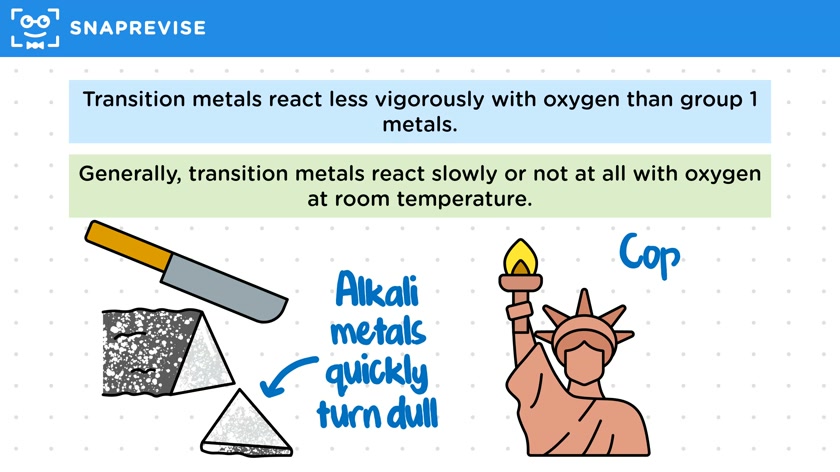
- Transition metals react less vigorously with oxygen than Group one metals.
- Alkaline metals tarnish quickly when exposed to oxygen, while transition metals react slowly or not at all at room temperature.
- The Statue of Liberty, made from copper, slowly reacted with oxygen over 20-30 years to form copper oxide, giving it a blue-green color.
- Some transition metals react with oxygen when heated, forming metal oxides, such as nickel forming black nickel oxide at 400 degrees Celsius.
- Transition metals react much less vigorously with halogens than Group one metals.
- Gold does not react with chlorine gas, while some transition metals react slowly.
- Heated iron reacts with chlorine gas to form iron three chloride, a dark greenish-black solid.
- Some transition metals react with halogens when heated, but the reactions are less vigorous than those of alkaline metals.
Please subscribe to access these revision notes.
This, and all other video notes, are included in our premium subscriptions.
Premium accounts get access to all videos and revision notes.
Report an Issue
Spotted something wrong? Let us know and we'll take a look.