
GCSE Chemistry (AQA)
196 videos | 19 hours
Please subscribe to watch this video.
This, and all other videos, are included in our premium subscriptions.
Premium accounts get access to all videos.
Enable autoplay to keep watching
Your browser is blocking videos from playing automatically. To turn it back on:
Safari (Mac): Click the Safari menu item in the top bar, then Settings → Websites → Auto-Play, then set Auto-Play to Allow All Auto-Play for the current website.
Safari (iPhone/iPad): open the Settings app, then Apps → Safari → Auto-Play, and select Allow All Auto-Play.
Quantitative chemistry
Yield and atom economy of chemical reactions
Reaction Pathways
7:14
Atom Economy of Reactions
Spec
4.3.3.2
- There are often multiple methods to produce a desired product.
- A reaction pathway outlines the sequence of reactions to create a product.
- Two methods for producing a product: Pathway A involves splitting a large molecule into a desired product and a byproduct; Pathway B involves two stages and produces only the desired product.
- Factors influencing the choice of reaction pathway include atom economy, percentage yield, rate of reaction, equilibrium position, and usefulness of byproducts.
- These factors impact profit and waste in industrial processes.
- Pathways with high atom economy result in more useful products and less waste.
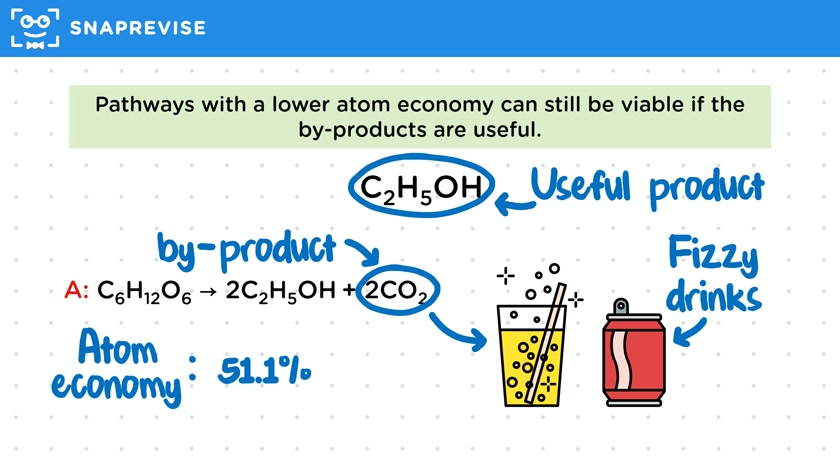
- Ethanol can be produced via fermentation (Pathway A) or reacting ethene with steam (Pathway B).
- Pathway A has an atom economy of 51.1% due to byproducts, while Pathway B has 100% atom economy.
- Byproducts can be useful, e.g., carbon dioxide from Pathway A can be sold to fizzy drinks manufacturers.
- High percentage yield pathways use reactants more efficiently and produce less waste.
- Pathway A has a 15% yield, while Pathway B has a 95% yield.
- Pathway B's yield is not 100% due to reversibility, but recirculating reactants increases yield.
- High reaction rate pathways produce products more quickly.
- Pathway A initially has a higher reaction rate than Pathway B.
- Reversible pathways have equilibrium points affected by reaction conditions, impacting yield.
- The Haber process is an example where temperature and pressure affect ammonia yield.
- In industry, a balance between speed, economy, and yield is sought.
- For exams, understanding why a reaction pathway is chosen based on atom economy, yield, rate, equilibrium, and byproduct usefulness is important.
Please subscribe to access these revision notes.
This, and all other video notes, are included in our premium subscriptions.
Premium accounts get access to all videos and revision notes.
Report an Issue
Spotted something wrong? Let us know and we'll take a look.