
GCSE Chemistry (AQA)
196 videos | 19 hours
Please subscribe to watch this video.
This, and all other videos, are included in our premium subscriptions.
Premium accounts get access to all videos.
Enable autoplay to keep watching
Your browser is blocking videos from playing automatically. To turn it back on:
Safari (Mac): Click the Safari menu item in the top bar, then Settings → Websites → Auto-Play, then set Auto-Play to Allow All Auto-Play for the current website.
Safari (iPhone/iPad): open the Settings app, then Apps → Safari → Auto-Play, and select Allow All Auto-Play.
Quantitative chemistry
Using concentrations of solutions in mol/dm3
Concentration of Solutions (mol/dm3)
9:22
Calculating Concentration Using Moles and Volume
Spec
4.3.4
- Concentration can be measured in grams per decimeter cubed or moles per decimeter cubed.
- Concentration is a measure of how much solute is present per decimeter cubed of a solution.
- Calculation for concentration in moles per decimeter cubed: amount of solute in moles divided by the volume in decimeters cubed.
- Example: 2 moles of solute in 0.5 decimeters cubed solvent results in a concentration of 4 moles per decimeter cubed.
- Volume should be converted to decimeters cubed before calculating concentrations.
- If concentration in moles per decimeter cubed is known, the amount of solute in moles can be calculated by rearranging the equation.
- Example with hydrochloric acid: 0.5 moles per decimeter cubed concentration and 0.1 decimeters cubed volume results in 0.05 moles of solute.
- The amount of solute in moles can be used to calculate the mass of solute in grams using the equation M = N x Mr.
- Example: Hydrochloric acid has a relative formula mass of 36.5, resulting in 0.00137 grams of solute.
- Concentration can be converted between grams per decimeter cubed and moles per decimeter cubed using the relative formula mass.
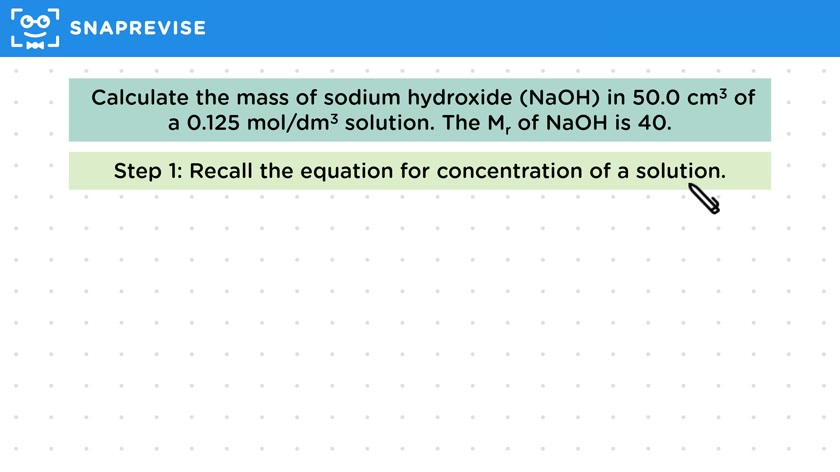
- Example calculation: Mass of sodium hydroxide in 50.0 cm�� of a 0.125 mole per decimeter cubed solution.
- Steps: Recall the concentration equation, rearrange for the amount of solute, convert volume to decimeters cubed, substitute values, calculate mass using M = N x Mr.
- Concentration is affected by the volume of solvent and the amount of solute.
- Increasing solvent volume decreases concentration; increasing solute amount increases concentration.
Please subscribe to access these revision notes.
This, and all other video notes, are included in our premium subscriptions.
Premium accounts get access to all videos and revision notes.
Report an Issue
Spotted something wrong? Let us know and we'll take a look.