
GCSE Chemistry (AQA)
196 videos | 19 hours
Please subscribe to watch this video.
This, and all other videos, are included in our premium subscriptions.
Premium accounts get access to all videos.
Enable autoplay to keep watching
Your browser is blocking videos from playing automatically. To turn it back on:
Safari (Mac): Click the Safari menu item in the top bar, then Settings → Websites → Auto-Play, then set Auto-Play to Allow All Auto-Play for the current website.
Safari (iPhone/iPad): open the Settings app, then Apps → Safari → Auto-Play, and select Allow All Auto-Play.
Energy changes
Chemical cells and fuel cells
Fuel Cells
4:26
Reactions at Electrodes in Hydrogen Fuel Cells
Spec
4.5.2.2
- Fuel cells use an external source of fuel.
- Hydrogen is typically used as the fuel in these cells.
- Fuel cells produce a potential difference (voltage).
- Fuel cells need a constant supply of fuel and oxygen.
- Hydrogen fuel cells require a constant supply of hydrogen and oxygen.
- The fuel reacts with oxygen to produce a potential difference, causing an electric current to flow.
- Fuel cells utilize an electrochemical oxidation process instead of combustion.
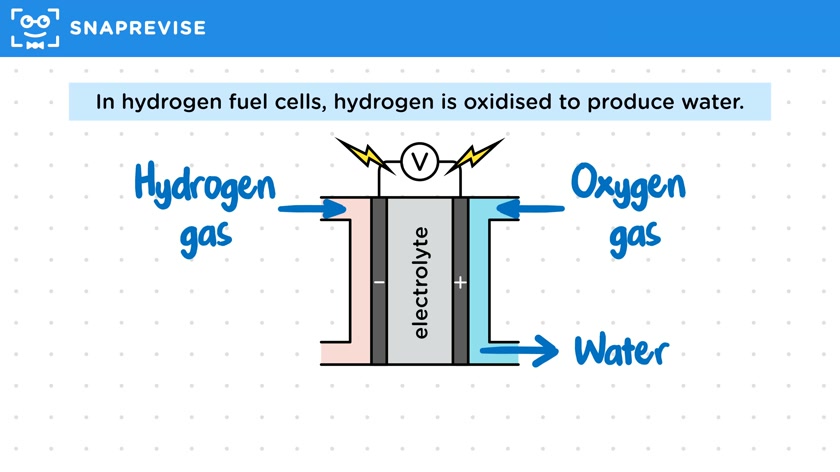
- In hydrogen fuel cells, hydrogen is oxidized to produce water.
- Hydrogen gas is pumped in on one side, and oxygen gas is pumped in on the other.
- The chemical equation for the reaction is 2H2 (gas) + O2 (gas) ��� 2H2O (liquid).
- Hydrogen fuel cells offer a potential alternative to rechargeable cells and batteries.
- Rechargeable cells require access to electricity to be recharged.
- Hydrogen fuel cells produce water as their only chemical product, which can be used in drinking water.
- Hydrogen fuel cells have no moving parts, making them easy to maintain.
- Disadvantages of hydrogen fuel cells include high manufacturing costs and the need for a constant supply of hydrogen fuel.
- Hydrogen fuel takes up a large volume and is explosive, requiring high-pressure storage.
Please subscribe to access these revision notes.
This, and all other video notes, are included in our premium subscriptions.
Premium accounts get access to all videos and revision notes.
Report an Issue
Spotted something wrong? Let us know and we'll take a look.