
GCSE Chemistry (AQA)
196 videos | 19 hours
Please subscribe to watch this video.
This, and all other videos, are included in our premium subscriptions.
Premium accounts get access to all videos.
Enable autoplay to keep watching
Your browser is blocking videos from playing automatically. To turn it back on:
Safari (Mac): Click the Safari menu item in the top bar, then Settings → Websites → Auto-Play, then set Auto-Play to Allow All Auto-Play for the current website.
Safari (iPhone/iPad): open the Settings app, then Apps → Safari → Auto-Play, and select Allow All Auto-Play.
Chemical changes
Electrolysis
Extraction of Aluminium
5:15
Electrolysis of Ionic Compounds and Metal Extraction
Spec
4.4.3.3
- Aluminum is a metal with many applications such as cans, foils, roofing, and car bodies.
- It is the second most used metal after iron and the most abundant metal on earth.
- Aluminum is found in ores and rocks, commonly in bauxite as aluminum oxide (Al2O3).
- Aluminum must be extracted using electrolysis, a process that separates ions in an ionic compound.
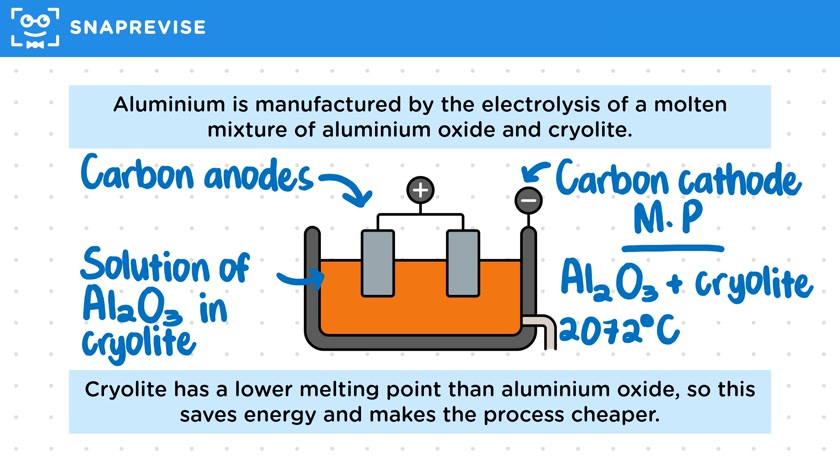
- Aluminum is manufactured by the electrolysis of a molten mixture of aluminum oxide and cryolite.
- Electrodes in the process are made with carbon instead of metal.
- The container itself is used as the cathode in the setup.
- Cryolite is used as a molten solvent to dissolve aluminum oxide, allowing ions to move freely.
- Cryolite has a lower melting point than aluminum oxide, saving energy and reducing costs.
- The melting point of aluminum oxide is over 2000 degrees, but with cryolite, it drops to under 1000 degrees.
- Aluminum ions are attracted to the cathode, gain electrons, and form aluminum metal.
- The process is kept at a high temperature, so aluminum is in a molten state and sinks to the bottom.
- Liquid aluminum is collected from the bottom of the container.
- Oxide ions are attracted to the anodes, lose electrons, and form oxygen molecules.
- Oxygen reacts with the carbon anode to form carbon dioxide, causing the anode to burn away.
- The anode needs to be continually replaced to maintain a complete circuit for electrolysis.
Please subscribe to access these revision notes.
This, and all other video notes, are included in our premium subscriptions.
Premium accounts get access to all videos and revision notes.
Report an Issue
Spotted something wrong? Let us know and we'll take a look.