
GCSE Chemistry (AQA)
196 videos | 19 hours
Please subscribe to watch this video.
This, and all other videos, are included in our premium subscriptions.
Premium accounts get access to all videos.
Enable autoplay to keep watching
Your browser is blocking videos from playing automatically. To turn it back on:
Safari (Mac): Click the Safari menu item in the top bar, then Settings → Websites → Auto-Play, then set Auto-Play to Allow All Auto-Play for the current website.
Safari (iPhone/iPad): open the Settings app, then Apps → Safari → Auto-Play, and select Allow All Auto-Play.
Chemical changes
Electrolysis
Electrolysis of Molten Ionic Compounds
5:31
Electrolysis of Ionic Compounds and Aluminium Extraction
Spec
4.4.3.2
- Simple ionic compounds can be separated into ions using electrolysis when in a molten state.
- Each molecule in a simple ionic compound consists of two ions, one positive and one negative, held together by opposite charges.
- Example: Electrolysis setup to separate lead and bromine from lead bromide.
- Molten lead bromide allows charged ions to move freely, making it an electrolyte that can carry an electric current.
- Graphite electrodes are used as they are good conductors and do not react with lead bromide.
- Electrodes are connected to a power supply to create a complete circuit.
- Metal is produced at the cathode, which gains a negative charge from the power supply.
- Lead ions (Pb2+) are attracted to the negatively charged cathode, gain electrons, and form neutral lead atoms.
- Liquid lead metal collects at the bottom.
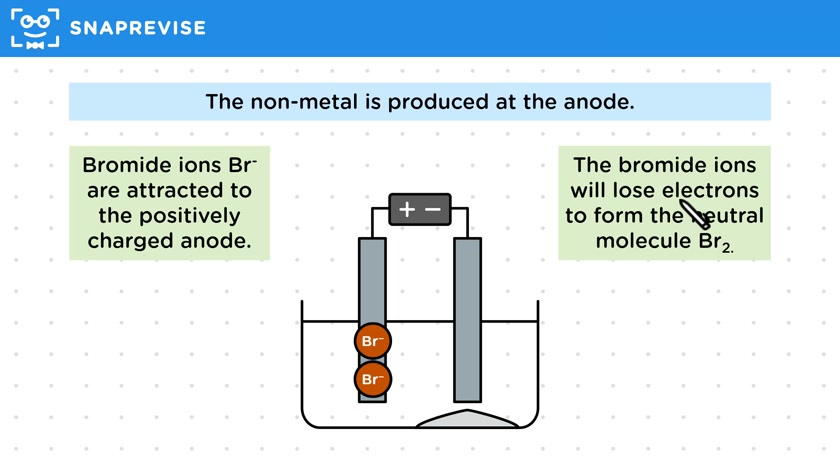
- Non-metal is produced at the anode, which is positively charged.
- Bromide ions (Br-) are attracted to the positively charged anode, lose electrons, and form bromine gas (Br2).
- Bubbles of bromine gas form at the anode.
- Predicting products of electrolysis involves identifying ions present and their charges.
- Example: Electrolysis of molten potassium chloride.
- Potassium chloride consists of potassium ions (K+) and chloride ions (Cl-).
- Potassium ions are attracted to the cathode, forming potassium metal.
- Chloride ions are attracted to the anode, forming chlorine gas (Cl2).
Please subscribe to access these revision notes.
This, and all other video notes, are included in our premium subscriptions.
Premium accounts get access to all videos and revision notes.
Report an Issue
Spotted something wrong? Let us know and we'll take a look.