
GCSE Chemistry (AQA)
196 videos | 19 hours
Please subscribe to watch this video.
This, and all other videos, are included in our premium subscriptions.
Premium accounts get access to all videos.
Enable autoplay to keep watching
Your browser is blocking videos from playing automatically. To turn it back on:
Safari (Mac): Click the Safari menu item in the top bar, then Settings → Websites → Auto-Play, then set Auto-Play to Allow All Auto-Play for the current website.
Safari (iPhone/iPad): open the Settings app, then Apps → Safari → Auto-Play, and select Allow All Auto-Play.
Bonding, structure, and the properties of matter
Chemical bonds, ionic, covalent and metallic
Covalent Bonding
2:05
Different types of Chemical Bonds
Spec
4.2.1.1
4.2.1.4
- Covalent bonding occurs in most non-metallic elements and in compounds of non-metals.
- Common examples of substances with covalent bonding: water, oxygen, carbon dioxide, and diamond.
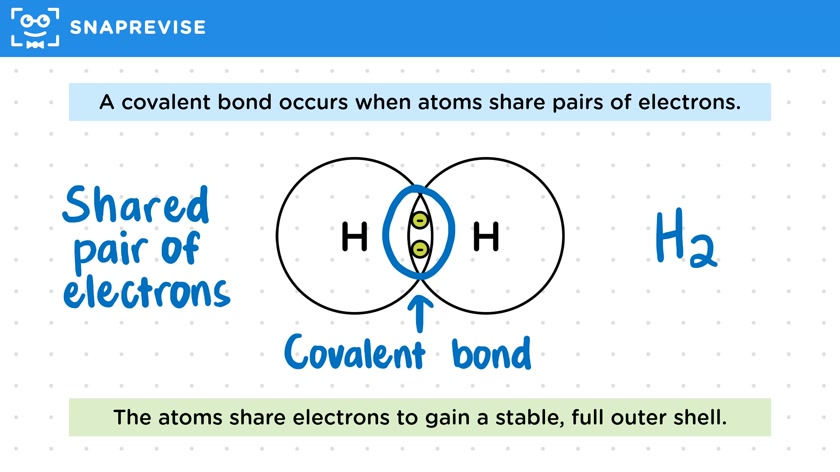
- A covalent bond occurs when atoms share pairs of electrons.
- Example: Two hydrogen atoms each with one electron in their outer shells can combine to form an H2 molecule.
- Shared pair of electrons between hydrogen atoms creates a covalent bond.
- Atoms share electrons to gain a stable full outer shell.
- Covalent compounds are held together by the attraction between the nuclei of each atom and the shared pair of electrons.
- Covalent bonds are strong due to the strong forces of attraction between the shared pair of electrons and the nuclei.
- More than one pair of electrons can be shared, forming multiple covalent bonds.
- Single bond: One pair of electrons shared (e.g., hydrogen molecule).
- Double bond: Two pairs of electrons shared (e.g., oxygen molecule).
- Triple bond: Three pairs of electrons shared (e.g., nitrogen molecule).
Please subscribe to access these revision notes.
This, and all other video notes, are included in our premium subscriptions.
Premium accounts get access to all videos and revision notes.
Report an Issue
Spotted something wrong? Let us know and we'll take a look.