
GCSE Biology (AQA)
331 videos | 14 hours
Please subscribe to watch this video.
This, and all other videos, are included in our premium subscriptions.
Premium accounts get access to all videos.
Enable autoplay to keep watching
Your browser is blocking videos from playing automatically. To turn it back on:
Safari (Mac): Click the Safari menu item in the top bar, then Settings → Websites → Auto-Play, then set Auto-Play to Allow All Auto-Play for the current website.
Safari (iPhone/iPad): open the Settings app, then Apps → Safari → Auto-Play, and select Allow All Auto-Play.
Bioenergetics
Respiration
Aerobic Respiration
2:18
Types of Respiration
Spec
4.4.2.1
- Aerobic respiration is a reaction that occurs in the mitochondria of cells.
- It involves the transfer of energy by reacting glucose with oxygen.
- Glucose, a type of sugar, reacts with oxygen in the mitochondria, found within the cytoplasm of cells.
- The term "mitochondrion" is singular and "mitochondria" is plural.
- The energy produced is vital for cellular processes.
- Respiration is an exothermic reaction, releasing energy outward and producing carbon dioxide and water as waste.
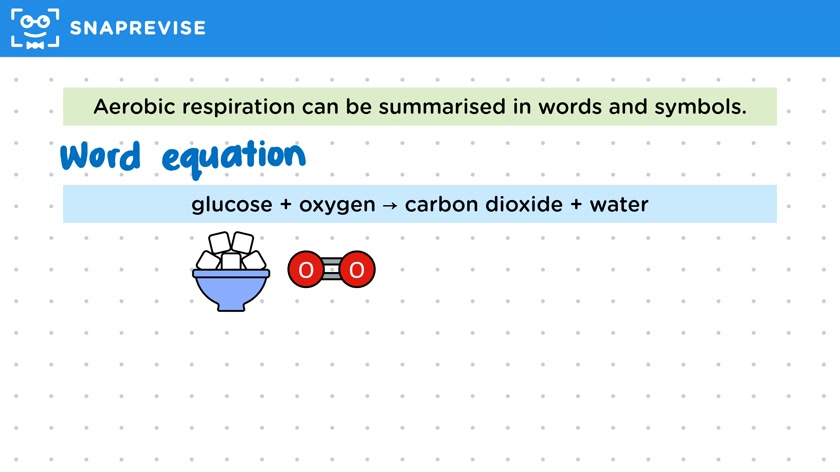
- The word equation for aerobic respiration is: glucose plus oxygen gives carbon dioxide and water.
- The symbol equation for aerobic respiration is represented as: glucose (C6H12O6) plus oxygen (O2) gives carbon dioxide (CO2) and water (H2O).
- To balance the symbol equation, add coefficients to ensure equal numbers of each type of atom on both sides of the equation.
- The balanced symbol equation for aerobic respiration includes six molecules of oxygen, six molecules of carbon dioxide, and six molecules of water, ensuring equal numbers of carbon, hydrogen, and oxygen atoms on both sides.
Please subscribe to access these revision notes.
This, and all other video notes, are included in our premium subscriptions.
Premium accounts get access to all videos and revision notes.
Report an Issue
Spotted something wrong? Let us know and we'll take a look.