
GCSE Physics (AQA)
346 videos | 23 hours
Please subscribe to watch this video.
This, and all other videos, are included in our premium subscriptions.
Premium accounts get access to all videos.
Enable autoplay to keep watching
Your browser is blocking videos from playing automatically. To turn it back on:
Safari (Mac): Click the Safari menu item in the top bar, then Settings → Websites → Auto-Play, then set Auto-Play to Allow All Auto-Play for the current website.
Safari (iPhone/iPad): open the Settings app, then Apps → Safari → Auto-Play, and select Allow All Auto-Play.
Electricity
Static electricity
Static Charge
2:01
Static Electricity and Electric Fields
Spec
4.2.5.1
- Static charge is a buildup of charge on the surface of an object.
- The surface has a negative charge due to more electrons than protons.
- Electrons are negatively charged, and the charge is stationary, meaning no current flows.
- No complete circuit or power source is present for current flow.
- Static charge can be produced by rubbing certain insulators together.
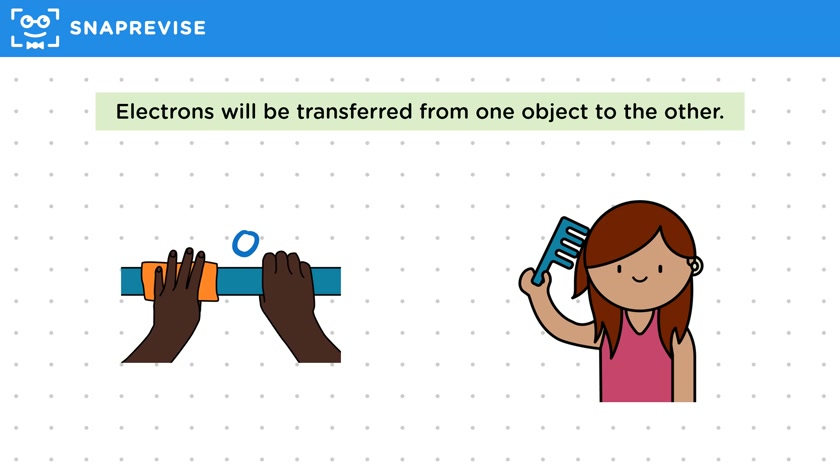
- Examples include rubbing a perspex rod with a cloth, combing hair, or rubbing a balloon against hair or a jumper.
- Electrons are transferred from one object to another during these processes.
- The object gaining electrons becomes negatively charged, while the one losing electrons becomes positively charged.
- The cloth becomes negatively charged, and the rod becomes positively charged.
- The hair becomes positively charged, and the comb becomes negatively charged.
- There is a transfer of electrons in these examples, but specific electron transfer directions are not required for exams without further information.
Please subscribe to access these revision notes.
This, and all other video notes, are included in our premium subscriptions.
Premium accounts get access to all videos and revision notes.
Report an Issue
Spotted something wrong? Let us know and we'll take a look.