
GCSE Physics (AQA)
346 videos | 23 hours
Please subscribe to watch this video.
This, and all other videos, are included in our premium subscriptions.
Premium accounts get access to all videos.
Enable autoplay to keep watching
Your browser is blocking videos from playing automatically. To turn it back on:
Safari (Mac): Click the Safari menu item in the top bar, then Settings → Websites → Auto-Play, then set Auto-Play to Allow All Auto-Play for the current website.
Safari (iPhone/iPad): open the Settings app, then Apps → Safari → Auto-Play, and select Allow All Auto-Play.
Forces
Forces and their interactions
Resultant Force
2:33
Resultant Force
Spec
4.5.1.2
4.5.1.4
- Forces are vector quantities with both magnitude and direction.
- Forces can be represented as arrows, with the arrow's direction showing the force's direction and its length indicating the force's strength.
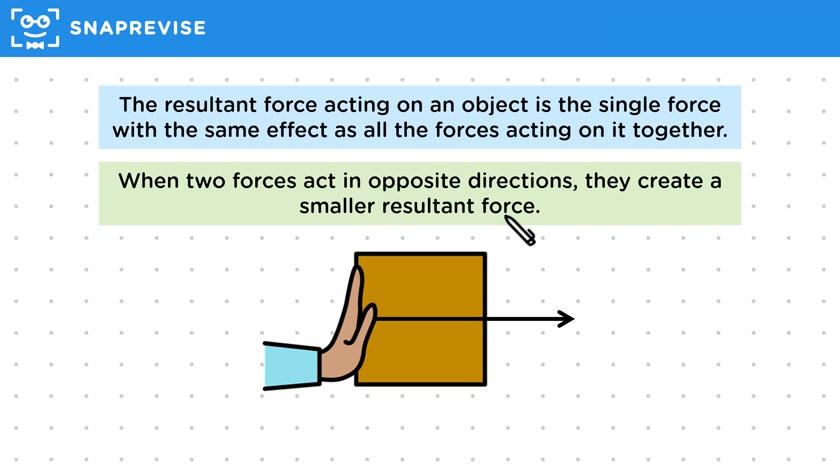
- The resultant force is the single force that has the same effect as all forces acting together on an object.
- When two forces act in the same direction, they create a larger resultant force.
- If a second person pushes a box in the same direction, the resultant force increases due to combined forces.
- When two forces act in opposite directions, they create a smaller resultant force.
- If a second person pushes a box in the opposite direction, the resultant force decreases, and the larger force prevails.
- Most systems have multiple forces acting on them simultaneously.
- Example 1: A falling apple experiences gravity pulling it down and air resistance pushing it up. The apple falls with a smaller resultant force than its weight due to gravity being the larger force.
- Example 2: An accelerating moped has a driving force from the engine opposed by friction and other resistive forces. The resultant force allows acceleration but slower than without resistive forces.
- To maintain a constant speed, the driving force must balance the friction.
- Understanding and explaining how forces interact and describing the resultant force is important for exams.
Please subscribe to access these revision notes.
This, and all other video notes, are included in our premium subscriptions.
Premium accounts get access to all videos and revision notes.
Report an Issue
Spotted something wrong? Let us know and we'll take a look.