
GCSE Physics (AQA)
346 videos | 23 hours
Please subscribe to watch this video.
This, and all other videos, are included in our premium subscriptions.
Premium accounts get access to all videos.
Enable autoplay to keep watching
Your browser is blocking videos from playing automatically. To turn it back on:
Safari (Mac): Click the Safari menu item in the top bar, then Settings → Websites → Auto-Play, then set Auto-Play to Allow All Auto-Play for the current website.
Safari (iPhone/iPad): open the Settings app, then Apps → Safari → Auto-Play, and select Allow All Auto-Play.
Atomic structure
Atoms and isotopes
Pre-Electron Ideas
2:13
History of the Atom
Spec
4.4.1.3
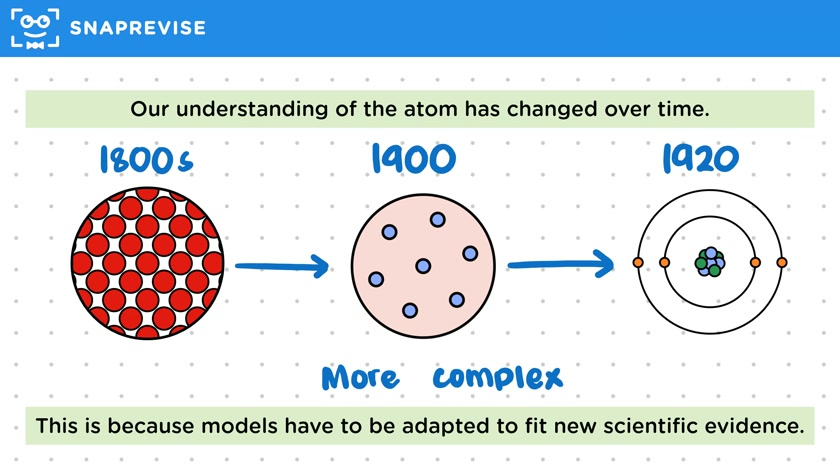
- Understanding of the atom has evolved over time.
- In the 1800s, atoms were thought to be indivisible.
- Around 1900, the electron was discovered, leading to the plum pudding model.
- The plum pudding model depicted atoms as positive charges with electrons inside.
- The shell model followed, with a nucleus at the center and electrons orbiting it.
- Models have become more complex with more subatomic particles and irregular arrangements.
- Models adapt to fit new scientific evidence.
- Scientific models are based on available information and can disprove theories.
- Exams require understanding the general order and progress of atomic models, not specific dates.
- The concept of atoms was first proposed by Greek philosopher Democritus around 400 BC.
- Democritus theorized matter was made of tiny, indivisible particles.
- Particles were considered the smallest piece of matter, with empty space between them.
- Non-contact forces between atoms are now known.
- Dalton formalized these ideas in the early 1800s, but exam details are not required.
Please subscribe to access these revision notes.
This, and all other video notes, are included in our premium subscriptions.
Premium accounts get access to all videos and revision notes.
Report an Issue
Spotted something wrong? Let us know and we'll take a look.