
GCSE Physics (AQA)
346 videos | 23 hours
Please subscribe to watch this video.
This, and all other videos, are included in our premium subscriptions.
Premium accounts get access to all videos.
Enable autoplay to keep watching
Your browser is blocking videos from playing automatically. To turn it back on:
Safari (Mac): Click the Safari menu item in the top bar, then Settings → Websites → Auto-Play, then set Auto-Play to Allow All Auto-Play for the current website.
Safari (iPhone/iPad): open the Settings app, then Apps → Safari → Auto-Play, and select Allow All Auto-Play.
Magnetism and electromagnetism
Permanent and induced magnetism, magnetic forces and fields
Permanent & Induced Magnetism
4:07
Introduction to Magnetic Fields
Spec
4.7.1.1
4.7.1.2
- Permanent magnets always produce a magnetic field.
- A bar magnet is an example of a permanent magnet with a constant magnetic field.
- Magnetic forces are strongest at the two poles of a magnet.
- Induced magnets only have a magnetic field in the presence of another magnetic field.
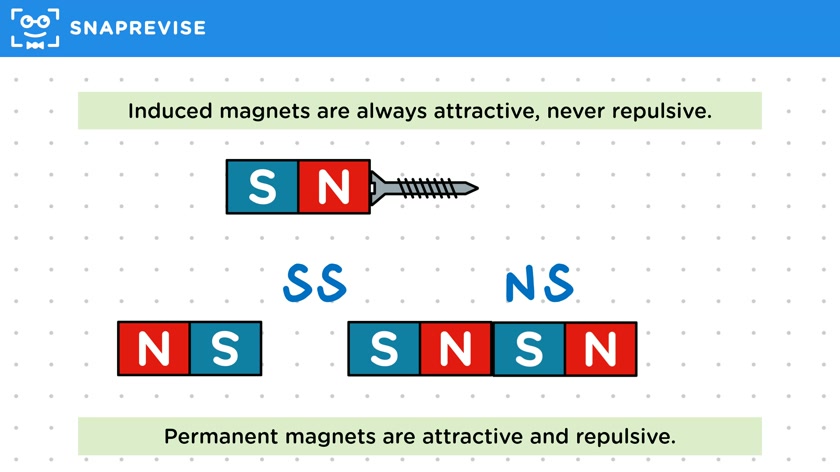
- A steel screw can be an example of an induced magnet.
- Normally, a screw doesn't have a magnetic field but acts like a magnet when in a bar magnet's field.
- Induced magnets are always attractive, never repulsive.
- Permanent magnets can be both attractive and repulsive.
- Permanent magnets have two poles: a north seeking pole and a south seeking pole.
- Unlike poles of permanent magnets attract each other, while like poles repel.
- For exams, it's important to explain the differences between permanent and induced magnets, especially the types of forces they enact.
- Induced magnets are always attracted to permanent magnets.
- A metal spoon can act as an induced magnet when placed in a bar magnet's field.
- The arrangement of poles in an induced magnet mirrors the magnet causing the induction.
- Induced magnets lose their magnetism when the permanent magnet is removed.
- Without the permanent magnet, the induced magnet cannot magnetize other objects, like a paperclip.
Please subscribe to access these revision notes.
This, and all other video notes, are included in our premium subscriptions.
Premium accounts get access to all videos and revision notes.
Report an Issue
Spotted something wrong? Let us know and we'll take a look.