
GCSE Physics (AQA)
346 videos | 23 hours
Please subscribe to watch this video.
This, and all other videos, are included in our premium subscriptions.
Premium accounts get access to all videos.
Enable autoplay to keep watching
Your browser is blocking videos from playing automatically. To turn it back on:
Safari (Mac): Click the Safari menu item in the top bar, then Settings → Websites → Auto-Play, then set Auto-Play to Allow All Auto-Play for the current website.
Safari (iPhone/iPad): open the Settings app, then Apps → Safari → Auto-Play, and select Allow All Auto-Play.
Atomic structure
Nuclear fission and fusion
Nuclear Fission
3:11
Nuclear Energy
Spec
4.4.4.1
- Nuclear fission is the process of a large nucleus splitting apart to become more stable.
- Nuclei are made up of protons and neutrons.
- Fission can happen to large nuclei that are too big to be held together, producing smaller nuclei and neutrons.
- The total number of protons and neutrons doesn't change during fission.
- Fission reactions rarely occur spontaneously.
- Uranium-235 is an isotope capable of fission but cannot do it spontaneously.
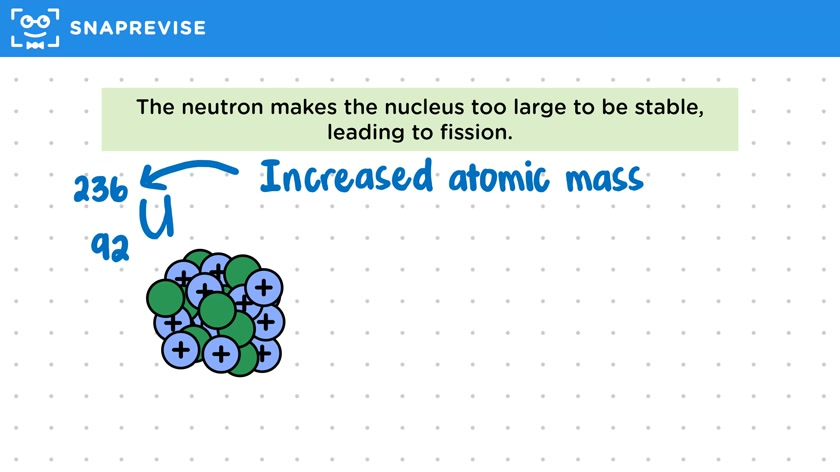
- Fission reactions usually occur when a large nucleus absorbs a neutron.
- A slow-moving neutron is easily absorbed by the nucleus, making it too large and unstable, leading to fission.
- During fission, the nucleus splits into two smaller nuclei roughly equal in size.
- Neutrons and gamma rays are also released during fission.
- Smaller nuclei typically undergo beta decay to become stable.
- During beta decay, a neutron becomes a proton, and an electron is released, making the nuclei more stable.
- Further decays may occur before the nuclei become completely stable.
- Understanding nuclear fission and its process is important for exams.
Please subscribe to access these revision notes.
This, and all other video notes, are included in our premium subscriptions.
Premium accounts get access to all videos and revision notes.
Report an Issue
Spotted something wrong? Let us know and we'll take a look.