
GCSE Physics (AQA)
346 videos | 23 hours
Please subscribe to watch this video.
This, and all other videos, are included in our premium subscriptions.
Premium accounts get access to all videos.
Enable autoplay to keep watching
Your browser is blocking videos from playing automatically. To turn it back on:
Safari (Mac): Click the Safari menu item in the top bar, then Settings → Websites → Auto-Play, then set Auto-Play to Allow All Auto-Play for the current website.
Safari (iPhone/iPad): open the Settings app, then Apps → Safari → Auto-Play, and select Allow All Auto-Play.
Space physics
Solar system; stability of orbital motions; satellites
Neutron Star & Black Holes
5:17
Life Cycle of a Star
Spec
4.8.1.2
- A supernova explosion compresses the core of a red super giant.
- Red super giants are large stars after their main sequence stage.
- Supernova leads to the creation of a neutron star for typical super giants.
- Neutron stars are made of tightly packed neutrons, with no protons or electrons.
- Neutron stars have a huge mass and are extremely dense, only a few kilometers wide.
- Density is calculated by dividing mass by volume; neutron stars have high density.
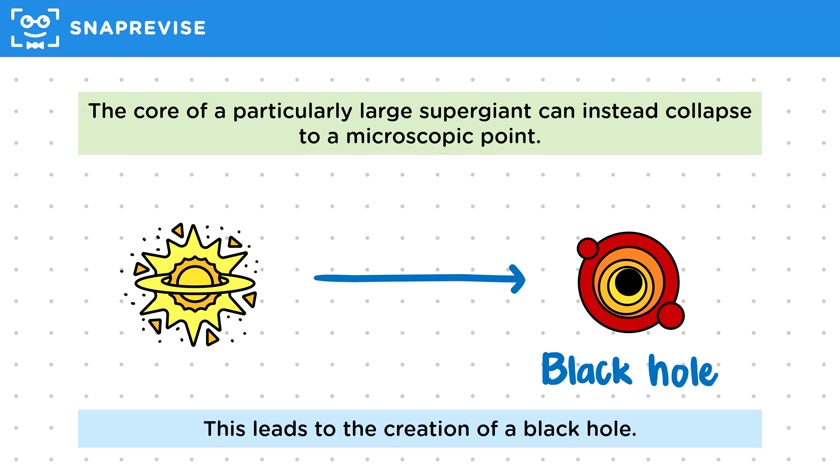
- Particularly large super giants can collapse into a black hole instead of a neutron star.
- Black holes have incredibly strong gravitational fields due to their mass.
- Nothing, not even light, can escape from a black hole, creating a "hole" appearance.
- Only massive main sequence stars can become black holes or neutron stars.
- Life stages of large stars: start as a cloud of dust and gas, become a proto star, then a red super giant, and finally a supernova.
- Most super giants become neutron stars after a supernova; only the most massive become black holes.
- Low mass stars cannot become neutron stars or super giants.
Please subscribe to access these revision notes.
This, and all other video notes, are included in our premium subscriptions.
Premium accounts get access to all videos and revision notes.
Report an Issue
Spotted something wrong? Let us know and we'll take a look.