
GCSE Physics (AQA)
346 videos | 23 hours
Please subscribe to watch this video.
This, and all other videos, are included in our premium subscriptions.
Premium accounts get access to all videos.
Enable autoplay to keep watching
Your browser is blocking videos from playing automatically. To turn it back on:
Safari (Mac): Click the Safari menu item in the top bar, then Settings → Websites → Auto-Play, then set Auto-Play to Allow All Auto-Play for the current website.
Safari (iPhone/iPad): open the Settings app, then Apps → Safari → Auto-Play, and select Allow All Auto-Play.
Magnetism and electromagnetism
The motor effect
Magnetic Field Around a Wire
4:18
Induced Magnetism
Spec
4.7.2.1
- All wires produce a magnetic field when conducting an electric current.
- No magnetic field is present when a charger is switched off and no current flows.
- A compass can detect a magnetic field by aligning to it instead of the earth's magnetic field.
- When a charger is switched on, the compass needle points towards the cable, indicating a magnetic field.
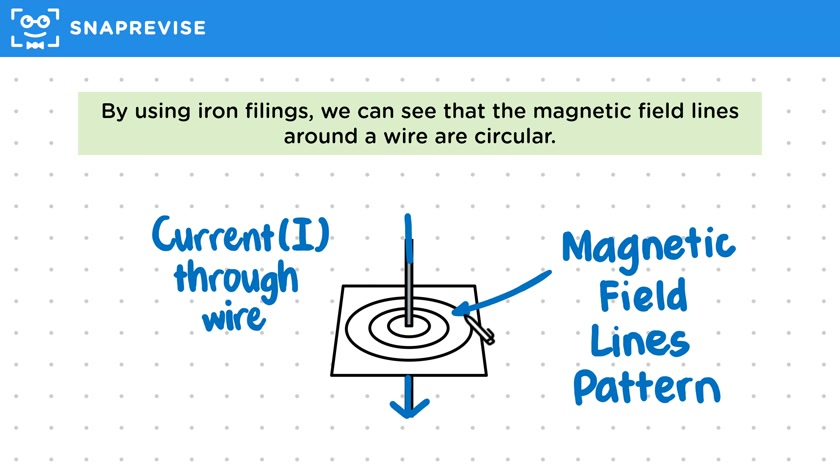
- The magnetic field around a wire is circular, as shown by iron filings.
- Field lines indicate the direction of force on a magnetic object.
- Iron filings align along magnetic field lines, forming concentric circles around a wire.
- The strength of the magnetic field depends on the distance from the wire and the current amount.
- Field strength is judged by the proximity of field lines; closer lines indicate a stronger field.
- Increasing current results in more and closer field lines, indicating greater field strength.
- The direction of the current determines the magnetic field's direction.
- The field direction affects the force on magnetic poles, with opposite forces on north and south poles.
- Reversing the current reverses the magnetic field direction.
Please subscribe to access these revision notes.
This, and all other video notes, are included in our premium subscriptions.
Premium accounts get access to all videos and revision notes.
Report an Issue
Spotted something wrong? Let us know and we'll take a look.