
GCSE Physics (AQA)
346 videos | 23 hours
Please subscribe to watch this video.
This, and all other videos, are included in our premium subscriptions.
Premium accounts get access to all videos.
Enable autoplay to keep watching
Your browser is blocking videos from playing automatically. To turn it back on:
Safari (Mac): Click the Safari menu item in the top bar, then Settings → Websites → Auto-Play, then set Auto-Play to Allow All Auto-Play for the current website.
Safari (iPhone/iPad): open the Settings app, then Apps → Safari → Auto-Play, and select Allow All Auto-Play.
Forces
Work done and energy transfer
Gravitational Potential Energy
4:13
Work, Kinetic Energy and Gravitaitonal Potential Energy
Spec
4.1.1.1
4.1.1.2
4.5.2
- Dropping from a height causes an object to gain kinetic energy.
- A diver gains kinetic energy from gravitational potential energy (GPE) despite no apparent input energy store.
- Gravity converts GPE to kinetic energy.
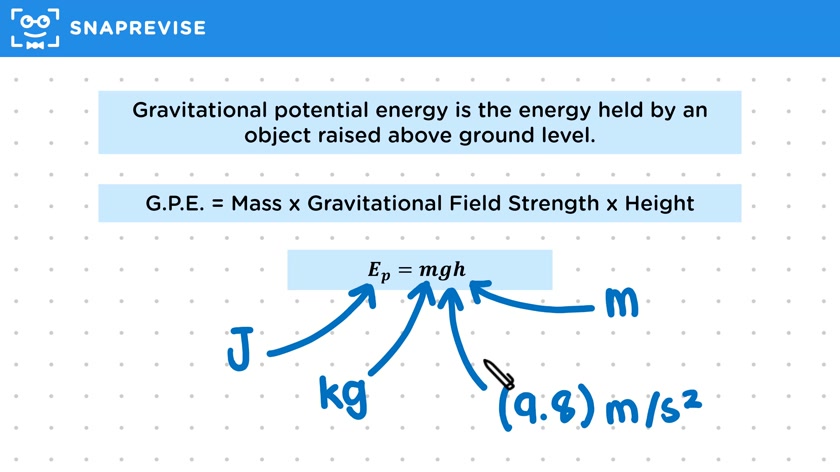
- GPE is energy held by an object raised above ground level or within a gravitational field.
- GPE formula: GPE = mass x gravitational field strength x height.
- Gravitational field strength is the force acting on a mass, determining weight force.
- The formula applies at a planet's surface where gravitational field strength is constant.
- GPE is measured in joules; mass in kilograms; height in meters; gravitational field strength in meters per second squared (9.8 on Earth's surface).
- The GPE equation is crucial for exams and GPE-related questions.
- Example: A 3 kg eagle with 100 kilojoules of GPE dives; calculate its height.
- Key information: mass = 3 kg, GPE = 100,000 joules, field strength = 9.8 m/s��.
- Rearrange GPE equation to solve for height: height = GPE / (mass x field strength).
- Substitute values: height = 100,000 J / (3 kg x 9.8 m/s��) = 3401.36 meters.
- Round height to two significant figures: 3,400 meters.
Please subscribe to access these revision notes.
This, and all other video notes, are included in our premium subscriptions.
Premium accounts get access to all videos and revision notes.
Report an Issue
Spotted something wrong? Let us know and we'll take a look.