
GCSE Physics (AQA)
346 videos | 23 hours
Please subscribe to watch this video.
This, and all other videos, are included in our premium subscriptions.
Premium accounts get access to all videos.
Enable autoplay to keep watching
Your browser is blocking videos from playing automatically. To turn it back on:
Safari (Mac): Click the Safari menu item in the top bar, then Settings → Websites → Auto-Play, then set Auto-Play to Allow All Auto-Play for the current website.
Safari (iPhone/iPad): open the Settings app, then Apps → Safari → Auto-Play, and select Allow All Auto-Play.
Space physics
Solar system; stability of orbital motions; satellites
Gravitational Orbits
2:56
Stars and the Solar System
Spec
4.8.1.3
- Two types of objects in space: planets and satellites.
- Planets orbit around the sun.
- Our solar system has a bright star, the sun, surrounded by eight planets.
- Each planet travels around the sun in a path called an orbit.
- Satellites orbit around planets.
- A satellite is defined as an object orbiting a planet.
- Earth's most well-known satellite is the moon, a natural satellite.
- There are also artificial satellites, like TV satellites, constructed and sent into space.
- Both natural and artificial satellites travel around the earth in set paths, called orbits.
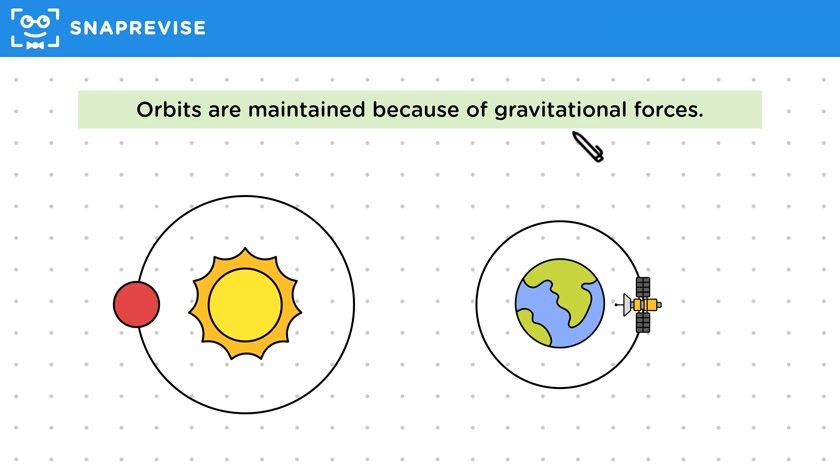
- Orbits are maintained due to gravitational forces, which are non-contact forces between objects with mass.
- Planets experience strong gravitational forces from the sun; satellites around the earth experience strong gravitational forces from it.
- Gravitational forces can be thought of as strings joining objects together, similar to spinning a ball on a string.
- Orbital paths are elliptical but can usually be treated as circular.
- Example: A moon orbiting Neptune has an elliptical orbit, meaning the distance between the moon and Neptune changes.
- This change is small, so orbits are often approximated as circular.
- This approximation is used for most orbits, including those between planets and the sun.
- In exams, assume an orbit is circular unless specified otherwise.
Please subscribe to access these revision notes.
This, and all other video notes, are included in our premium subscriptions.
Premium accounts get access to all videos and revision notes.
Report an Issue
Spotted something wrong? Let us know and we'll take a look.